Bespoke Product Engineering in a Commodity Cellphone Market
Mike Farish | April 23, 2015 Device production from 30 work stations has totaled 400,000 units since 1998. Image source: Vertu
Imposing high-security gates surrounding a business premise on the outskirts of Fleet—a town some 30 miles southwest of London—give a clue to the fact that the company behind the gates is rather out of the ordinary.
The business is Vertu, which employs 450 and designs and assembles what may well be the most exclusive and expensive mobile phones available anywhere in the world.
Materials involved include titanium for the phones' chasses, sapphire crystal for the screens and ruby bearings beneath the keys. Alternatives to leather covers include skins of stingray, calf, ostrich and karung (water snake with silky skin).
 Vertu for Bentley edition. Source: VertuFrom a current "entry level" price of £4,200 (roughly $6,900), prices range from around four times that for phones that will integrate with the non-driving functions on the dashboard of a Bentley automobile, to the-sky's-the-limit for the bespoke items the company will make if required. Founded in 1998, the company has since made about 400,000 phones in total. By comparison, the total world market in 2014 was a little over 1 billion units.
Upmarket Opportunity
The company's origins, however, are very much in the world of high-volume consumer products. The business started as a unit of mass market cellphone manufacturer Nokia. Hutch Hutchison, head of design, says that the phone-maker saw an opportunity to create a highly distinctive and decidedly upmarket brand in a sector otherwise dominated by a drive to achieve high market share through competitive pricing.
Even then, however, the aim was not simply to be a provider of luxury products that achieved a price premium through packaging standard components in expensively exotic casings.
“We have never been into bling," Hutchison says. Instead, he says the aim has been to make “better phones" designed to make use of materials and components that would provide extremes of performance as well as a distinctive appearance. “We are trying to design devices that will last for 10 years."
As such, a fundamentally important strategic principle was that Vertu should be a separate operation from its parent. Vertu took some senior personnel from Nokia—including Hutchison—and it recruits specialist staff from "leading edge" engineering operations outside of the mobile communications business. The latter have included the defense industry and auto racing's Formula 1. Hence, the ethos of the company is that of a high-precision engineering organization.
Handmade and High-Tech
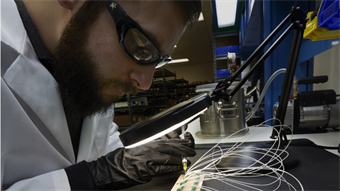
The company's production floor is not a highly automated production line environment and every phone is assembled from start to finish by a single worker at just one of more than 30 individual assembly stations. The final product is both "handmade" and "high-tech" making it a key selling point . That combination of factors is epitomized by the final process that each phone undergoes before it is packaged for shipping—the laser etching of the assembler's signature onto a metal tab inside the device cover.
As such, the skills of assembly staff are facilitated in a number of ways. One is that they are allowed to work at their own pace so that there is,as Hutchison concedes, a degree of “variability" in how long each worker will require to assemble a phone. To help ensure that workers are as attentive as possible, there is no night shift. In addition, Vertu’s workers tend to be older—most seem to be at least in their 40s—and they also tend to stick to the job once they have started. “There is a very low turnover," Hutchison says.
Automated procedures are not absent, but they are used for testing rather than manufacturing. After assembly, for instance, each phone is loaded on to a test station where around 200 attributes are analyzed in a routine that lasts more than four minutes.
Supply Chain
In mid-2012, Nokia reduced its stake so that Vertu could operate as an independent company. The change had implications for the company's relationship with its supply chain, particularly in terms of collaborative design work and design information communication.
Nokia had been foremost among what Vertu terms its “key collaboration partners," effectively the sole supplier of the printed circuit boards (PCBs) that form the electronic heart of any cellphone. But that working partnership ended leaving Vertu to find a new way of satisfying that requirement. The result has been achieved by constructing a global supply network with multiple business partners. Moreover, not only did the company establish new partnerships, but it did so in the context of a change in its technology and a recognition that it would need to be more proactive in incorporating leading edge technologies into those products.
In the first instance, Vertu was intent on changing the operating system of its products from Symbian to Android. On the second, it had to expand beyond a market share based largely on the material quality of its products by increasing its ability to make smartphones, a type of device it had introduced into its portfolio relatively recently.
That meant the company had to match its development cycle to those of other companies developing the key technologies that define and support smartphone capabilities. Hutchison says those technologies include batteries, CPUs and display components. Such companies work to compressed development cycles, meaning that the task for Vertu was not just to develop products in similarly short timescales but to develop them in parallel with the components they would contain. Doing so would help ensure that they would be appropriately state of the art when released to the market.
Product Design Tools
The choice of design technology that would support that transition was, therefore, crucial to its success. Much of the responsibility for making the decision fell to CAD Manager Tim Draper, who joined the company from sportscar maker McLaren just as the Nokia divestment was taking place. Draper says that Vertu's core 3D modeling system had effectively been dictated by the need to be compliant with Nokia. Hence, for several years it had been the CATIA V5 system from Dassault Systèmes. In fact, one of his first assignments upon joining Vertu was to oversee a projected transition to a newer V6 system.
The move to independence, however, offered Vertu the chance to stop that process and consider whether or not it was the correct path to follow. The more Vertu analyzed the situation, the more it came to the conclusion that was not the case.
 Compatibility with suppliers' CAD systems proved a critical business decisions in designing bespoke cellphones. Image source: VertuFor a start, Draper says that migrating from V5 to V6 was itself effectively a move to a new system rather than just an upgrade because the two software suites are constructed in completely different ways from each other. He describes the former as a “file system" whereas the latter as a “database system." As such, V6 does not facilitate the ability to organize working procedures in a way that would be appropriate for Vertu's product development methodology, which he says is both “collaborative" and “in parallel."
Another consideration was that neither version of CATIA was a majority choice of CAD technology within Vertu's supply chain. In fact, when Vertu carried out a survey to learn what systems did predominate, it found that 60% of its suppliers using CAD used software from Parametric Technology Corp. (PTC). That figure rose to 100% as far as “key suppliers" were concerned.
As such, the PTC software looked like a likely option, though it was still necessary to ensure that it could satisfy Vertu's “key performance benchmarks." That meant, Draper says, “support for all processes," not the least of which were collaborative working procedures. The subsequent analysis process took five weeks and in the end “was a pretty easy choice" with the formal decision made in July 2013.
What followed was a phased introduction of the PTC products that has now seen the company implement 45 seats of the Creo 3D CAD modelling package and 170 seats of its sibling Windchill product data management (PDM) package. The CAD element, Draper says, first went live three months after the decision was made. The introduction of Windchill followed two months later. The two were integrated a month later. The eight-month mark saw the first effective supplier collaboration, but a real landmark was reached after 12 months when fabrication of the first physical prototype to have been designed in Creo took place.
Draper says that the speed at which Vertu made that transition was remarkable. He says that switching from one high-end CAD modeling system to another often takes two to three times as long. A particular enabling factor was the ability of the PTC software to use effectively the dumb data—essentially geometrical information stripped of the history tree data that records how it was constructed—that is involved when CAD modeling information generated on one proprietary system is transferred to another. In practice, that means projects that have already started in the CATIA environment could be continued in the Creo world.
Vertu currently uses several in-house design tools in addition to Creo. These include the Cadence electronics design system for PCBs and the Rhino industrial design package for initial concept design of new products.
Draper says that though Vertu carries out in-house electronics design work in Cadence, its collaboration partners use their own electronics design systems.
“We lead the design process but our partners design the electronics according to our specifications from first principles," he says.
Meanwhile, the half dozen Rhino system seats are also new to the company. The software was brought into operation at the same time as Creo. Draper says that the aim was to free up the company's creative team by giving them an easy-to-use design system that was appropriate for their requirements. Previously, they had also used CATIA but, as he says, that system is a “parametric engineering design tool"—as is Creo—intended for quite a different purpose.
Redefining Engineering Roles
Effective use of the combination of Rhino and Creo have also involved devising a new way of working that has in turn required the creation of a new type of engineering designer within the company. Draper says that the conceptual design information that originates in Rhino must eventually become a precise and robust engineering design data within Creo. The information must, for instance, contain the “offset" information required to support automated downstream manufacturing processes such as plastic molding and, at the other extreme, accurate mating of metal and leather parts during manual assembly.
So a new role has been created entitled "surface architect," essentially an engineering designer who can interpret conceptual information in Rhino and re-create it in Creo in a way that supports downstream processes that require parametric 3D CAD data. Draper says this is analogous to the "Class A surfacers" in the automotive industry who transforms initial styling concepts into CAD modeling information. The point of this role is to construct “master" Creo surfaces that parametrically drive the mechanical 3D models. In turn, this enables design and engineering to work concurrently while allowing design changes to be easily implemented and automatically pushed into mechanical models. “This saves us loads of time," he says.
The first Vertu products to be designed and developed entirely in the new environment have yet to appear. But Draper says that the new configuration is now bedded in and that by the end of the first quarter, four distinct projects—no doubt all of them high price tag products—will be underway using the new software resources.
To contact the author of this article, email: engineering360editors@ihs.com