Shape-memory Effect Observed in a Flexible Metal Organic Material
S. Himmelstein | April 30, 2018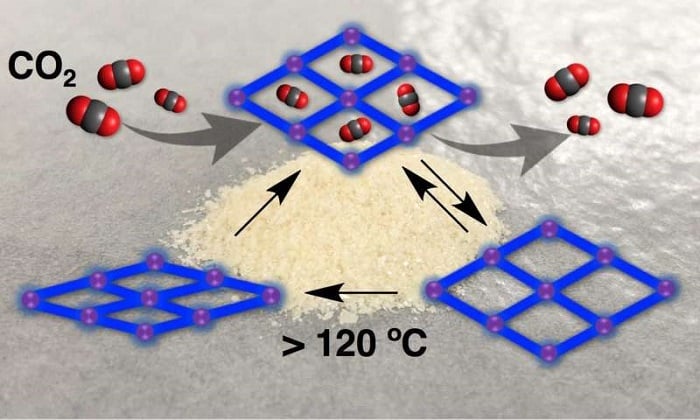 The crystal's pores remain open after releasing carbon dioxide, but can be collapsed when heated. Source: Kyoto University
A shape-memory effect has been demonstrated in a flexible metal organic material, the second such observation ever reported.
The international team of researchers developed crystals by dissolving a mixture of chemicals and zinc nitrate hexahydrate in dimethylformamide solvent at 120°C for 24 hours. Analysis of crystal structure by single-crystal X-ray diffraction revealed slightly distorted paddlewheel-shaped lattices, which were made of central zinc ions linked to surrounding organic molecules. This "alpha phase" of the crystal had 46 percent porosity, meaning that 46 percent of its volume was available for accepting new molecules. This property makes porous materials suitable for a variety of applications.
After heating the alpha crystal at 130°C in a vacuum for 12 hours, the crystal became more dense, its lattices became more distorted and its porosity was reduced to only 15 percent. This crystal structure was labeled the beta phase.
Carbon dioxide added at a temperature of -78°C was adsorbed into the crystal's pores and the crystal's shape changed to less-distorted lattices than those in the beta phase. The available volume for accepting guest molecules increased to 34 percent. When the researchers added and removed carbon dioxide from the crystal over ten consecutive cycles, they found that it retained its shape, resulting in a "shape-memory" gamma phase. Adding nitrogen or carbon monoxide under varying temperatures also induced the transformation of the crystal from its beta to its gamma phase.
The crystal's gamma phase was reverted back to its beta phase by heating it at 130°C in a vacuum for two hours. To revert to the alpha phase, the gamma phase of the crystal was soaked in dimethylformamide for five minutes.
Scientists from University of Limerick, Kyoto University and University of South Florida participated in this research, which is published in Science Advances.