
Study: Multicaloric materials can fuel cooling efficiency
S. Himmelstein | December 04, 2020The efficiency of magnetic cooling, a refrigeration technique based on the temperature change of a material caused by a magnetic field – or the magnetocaloric effect – can be improved with additional external stimuli. The effects of simultaneously exposing certain alloys to magnetic fields and mechanical stress were explored by an international research team in pursuit of refrigeration systems based on such multicaloric materials.
Tests were conducted with a nickel-manganese-indium magnetic shape memory alloy as a promising material. When exposed to a magnetic field, two different crystal lattices in the material meld together. At a certain temperature at which the crystal structures change, the magnetic properties of the compound are also altered.
The alloy was exposed to magnetic flux densities as high as 6 Tesla while also subjected to a compressive stress force of 50 megapascals. The adiabatic temperature change in pulsed magnetic fields and the influence of 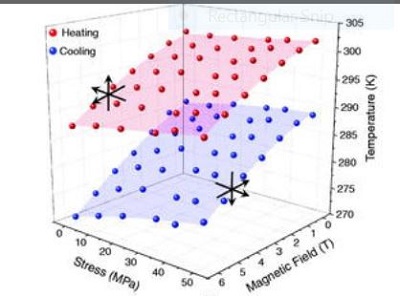 Transition temperatures as a function of magnetic field and uniaxial stress. Solid symbols indicate experimental data. The arrows in each plane indicate the changes in temperature, magnetic field, and stress to cross the plane. Source: Adrià Gràcia-Condal et al.uniaxial load were measured with a specially engineered calorimeter. The analysis also considered the alloy's entropy during programmed cooling and heating phases near a specific temperature at which the given material experiences transformations in the crystal lattice that lead to a change in magnetization.
The multicaloric response of the alloy was demonstrated to exceed that of single caloric effects. Combining a magnetic field with stress induces isothermal entropy and adiabatic temperature changes larger than those achievable when a single external stimulus is applied. The research published in Applied Physics Reviews highlights the utility of multicaloric materials for cooling applications in refrigeration devices designed to work at low values of the external fields.
Scientists from University of Barcelona, Helmholtz-Zentrum Dresden-Rossendorf (Germany), and Technical University of Darmstadt (Germany) participated in this research.

This discovery will provide a spectacular development for the refrigeration of components of electromechanical equipment.