Digital Microfluidic System Determines Immunity Levels in Vulnerable Populations
S. Himmelstein | April 27, 2018A portable digital microfluidics device has been designed to address the prevalence of preventable infectious 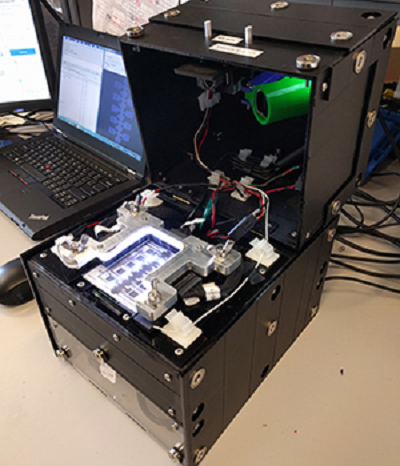 The MR Box on the lab bench in the Kenya refugee camp. Source: Wheeler Lab, University of Torontodiseases in developing areas. The reconfigurable lab-on-a-chip diagnostic platform developed at the University of Toronto determines the level of immunity to vaccine-preventable diseases among vulnerable populations. The desktop MR Box lab is configured to test for measles and rubella.
When field-tested at a refugee camp in remote Kenya, the low-cost system matched the international laboratory-standard reference tests of the Kenyan Medical Research Institute for 86 percent of measles samples, and 91 percent of rubella samples.
The chips are made using low-cost fabrication techniques such as ink-jet and 3D printing are used to manufacture the diagnostic chip. Sample droplets are controlled by applying electrical signals to different electrodes. The researchers suggest that with simple statistical analyses, the point-of-care system could be used to monitor the levels of immunity within dynamic populations and help prevent outbreaks.
The device might also be applied for disease monitoring at airports or other points of entry and is envisioned as a powerful tool for public health workers on the front lines, who have no access to health records, or may be dealing with humanitarian emergencies.
The research team is now developing new chips to test for different markers and diseases, including zika and malaria.