
Meet the World's Largest Electric Truck
S. Himmelstein | April 23, 2018Make way for the world's largest electric vehicle, which just started transporting lime and marl rocks from a higher mining area to a lower processing plant in Switzerland. When empty, the Lynx weighs 58 tons and has a payload of 65 tons.
The Lynx is touted as the largest and most powerful battery-powered electric wheeled vehicle in the world. 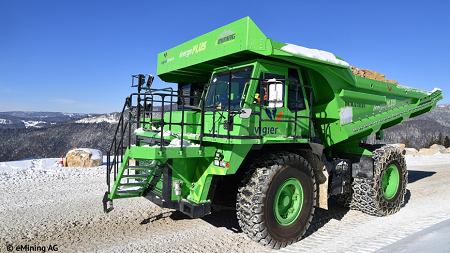 The eDumper does heavy work in the quarry of Vigier Ciment, Switzerland. Source: Andreas Sutter (Lithium Storage GmbH)The eDumper uses a 4.5 ton battery, the largest ever produced for an electric vehicle. Its task will be to transport more than 300,000 tons of rock per year over the next 10 years. Despite being super-sized, the vehicle is expected to save up to 1,300 tons of carbon dioxide and 500,000 liters of diesel over the next decade.
The batteries are charged during a fully loaded descent by recuperation of braking energy. The electricity generated in this way is sufficient for the empty return journey uphill to the mining are, making the e-Dumper a zero-energy vehicle.
Industry partners built the Lynx on the basis of a diesel-powered Komatsu HD 605-7 dump truck. In order to optimally size the electric drive, researchers at the Bern University of Applied Sciences at the Institute for Energy and Mobility Research IEM equipped the conventional model with a variety of sensors to provide measurement data. The necessary torque at the Cardan shaft and the power output of the engine are measured together with the respective driving condition and the GPS data of the vehicle.
The BFH Energy Storage Research Centre then addressed the suitability of battery cells and the cooling of a battery module. Lithium-ion cells were selected and evaluated in a special test facility housed in a shipping container.
To guarantee the longevity and robustness of the technology, the Interstate University of Applied Sciences Buchs investigated the vibrations of the diesel dump truck in real use and the heat emission of the battery cells of the future eDumper. The researchers also designed the thermal management for the battery pack, calculated the necessary strength of the battery holders and finalized welding seam parameters.
The Swiss Federal Laboratories for Materials Science and Technology Empa examined the behavior and safety of the Li-ion cells.


Mineral-electric power.
Just not renewable.