Fluorescent Silk Slays Harmful Bacteria
S. Himmelstein | April 20, 2018Conventional photocatalytic, or light-activated, technologies designed to kill harmful pathogens such as bacteria use potentially biohazardous semiconductors and require cancer-causing ultraviolet light for activation. A safer, all-natural alternative engineered by Purdue University and the Korean National Institute of Agricultural Research instead uses plasmonic photocatalyst-like biomaterials and visible light, which also aid in wound 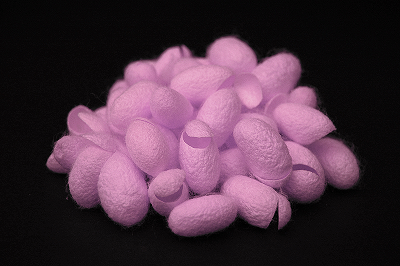 Shining a green light on red fluorescent silk activates a mechanism to kill pathogens. Source: Purdue University/Jung Woo Leemhealing and environmental remediation including air and water purification.
The silk hybrid material attacks bacteria when illuminated by a green light, thanks to a far-red fluorescent protein researchers transferred to its genetic makeup.
The gene for “mKate2,” a far-red fluorescent protein, was inserted into a silk host to realize the benefits of both silk and green light. Shining a green light on the resulting hybrid generates reactive oxygen species (ROS), which are effective radicals for breaking down organic contaminants and attacking the membrane and DNA of pathogens. The process adds fluorescence to silk to facilitate disinfection or decontamination by using visible light.
When E. coli on the fluorescent silk were illuminated by a weak green light for 60 minutes, the bacteria’s survival rate dropped to 45 percent.
The researchers contend that green-light activated red fluorescent silk could be both more efficient and scalable than other plasmonic photocatalysts, in which metal nanoparticles hybridized from semiconductor materials also use visible light but could still pose negative environmental consequences. Since ambient white light also includes green light, the silk hybrid material should have a strong enough light source to generate ROS as long as a green light controls ROS generation.
The research is published in Advanced Science.