Team Develops Sensor Array Capable of Locating Humans Trapped in Rubble
Marie Donlon | April 19, 2018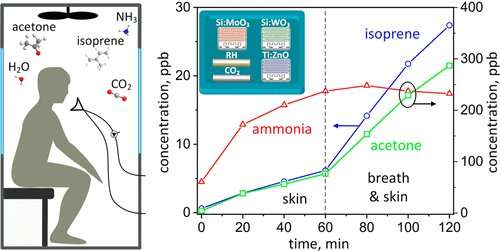 Source: ACSAn international team of scientists has developed a portable, lightweight and inexpensive sensor that can be used by first responders to search for survivors, who may be possibly covered in the rubble of a building collapse brought on by a natural disaster like an earthquake or another disaster such as a bombing.
Reporting on their device in the American Chemical Society (ACS) journal Analytical Chemistry, the team developed the sensor to help first responders and drones quickly locate people stuck in the rubble in the critical moments after the collapse of a building, thus increasing their chances of survival.
Current methods for locating survivors include human-sniffing dogs as well as acoustic probes that can pick up cries for help. However, these methods have disadvantages ranging from the limited availability of human-sniffing dogs to the possibility that victims are unconscious and incapable of crying out for help.
As such, Professor Sotiris E. Pratsinis of the Department of Mechanical and Process Engineering at ETH Zurich and a team of his colleagues have been at work on a sensor capable of detecting even the smallest signs of life. Using three existing gas sensors — each designed to specifically pick up on acetone, isoprene and ammonia, which are chemicals emitted by breath or skin — in combination with two sensors capable of detecting CO2 and humidity, the team built an inexpensive sensor array that fits in the palm of the user’s hand.
To demonstrate the effectiveness of the device, researchers simulated a human entrapment event during which the sensors quickly picked up on trace amounts of those chemicals.
The team plans to field test the sensor array in the near future.