
Methane’s Increasing Greenhouse Effect at the Earth’s Surface is Documented
S. Himmelstein | April 04, 2018Evidence that increasing concentrations of methane are leading to an increasing greenhouse effect in the 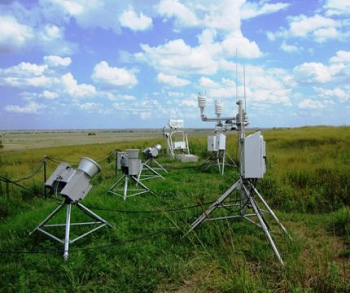 The scientists used radiometers to isolate the signal of methane’s greenhouse effect. Source: U.S. Department of Energy Atmospheric Radiation Measurement Climate Research FacilityEarth's atmosphere has been documented by researchers from the US Department of Energy’s Lawrence Berkeley National Laboratory. Data from a field observation site in northern Oklahoma indicate that the greenhouse effect from methane tracked the global pause in methane concentrations in the early 2000s and began to increase at the same time that concentrations began to rise in 2007.
Highly calibrated, long-term measurements were analyzed to isolate the changing greenhouse effect of methane. The researchers examined measurements over the wavelengths at which methane exerts its greenhouse effect and coupled these with a suite of other atmospheric measurements to control for other confounding factors, including water vapor.
The trend in methane-associated radiative forcing observed after 2006 was 0.026 ± 0.006 (99.7% CI) W m2 yr−1. The seasonal-cycle amplitude and secular trends in forcing are influenced by a corresponding seasonal cycle and trend in atmospheric methane.
This study was enabled by the comprehensive measurements of the Earth’s atmosphere that the U.S. Department of Energy has routinely collected for decades at its Atmospheric Radiation Measurement facilities.



Methane is at least 2 to 4 times worse for global warming than is carbon dioxide...
Burning-off methane breaks down methane into smaller quantities of oxygen, hydrogen, carbon dioxide, water, etc., molecules, which, on average, are much less damaging to the atmosphere than is methane...
As an affordable stop-gap, time-buying, measure, why not mitigate the effects of methane by wide-spread efforts to burn it off, until better process(es) are developed?...
They better be careful. If the Trump administration hears of this research, they may lose their funding.
In reply to #2
I rather think that, if someone got a grant to conduct a relatively small-scale study to quantify the results of burning off the (soil gases) of a single Landfill, say, and made at least small amount of profit in the process, then (the Trump Administration) might well fund a larger effort in order to create a few more jobs while reversing air pollution in the process, or at least invite crowd-sourcing efforts to pursue such alternatives...
..such as installing wind mills and solar panels both on the landfill, as well...
In any case, what is your best suggested solution?...
In reply to #3
Do it anyway.
In reply to #4
Do exactly what anyway?...