
Once Carbon Dioxide is Captured, Here’s What You Can Do With It
Peter Brown | March 29, 2018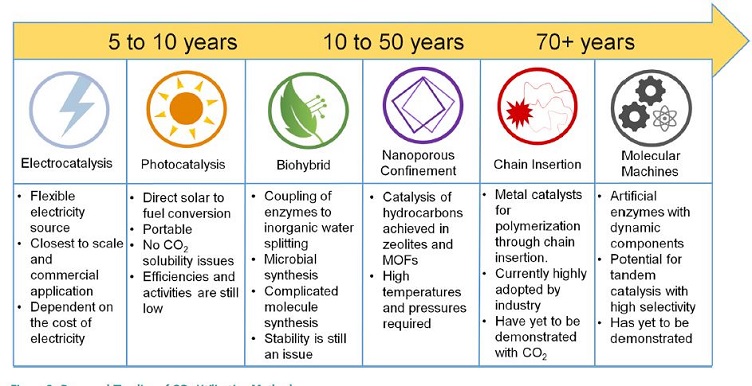 Uses for CO2 after it has been captured over the next decades and longer. Source: University of Toronto
Thousands of metric tons of carbon dioxide comes from power plants each year, all of which goes into the atmosphere.
But what if we could harness the carbon dioxide waste and convert it into useful material? Not only would this help curb greenhouse gas emissions but it could offer a new way to create molecules for feedstock, biofuels, pharmaceuticals or renewable fuels.
Researchers from the University of Toronto in collaboration with the U.S. National Renewable Energy Laboratory (NREL) have identified a series of possible small molecules that make economic sense and could be made by converting captured carbon dioxide.
"Similar to how a plant takes carbon dioxide, sunlight, and water to make sugars for itself, we are interested in using technology to take energy from the sun or other renewable sources to convert carbon dioxide into small building block molecules which can then be upgraded using traditional means of chemistry for commercial use," says Phil De Luna, a Ph.D candidate in materials science at the University of Toronto. "We're taking inspiration from nature and doing it faster and more efficiently."
Captured carbon dioxide could be used in energy storage using hydrogen, methane and ethane as biofuels while ethylene and ethanol could serve as the building blocks for a range of consumer goods. Furthermore, carbon dioxide-derived formic acid could be used by the pharmaceutical industry or as a fuel in fuel cells.
Researchers warn that technologies to capture carbon dioxide waste is still in its infancy with a few startups developing strategies for commercial use. The team believes in the coming decades major improvements will be made to capture carbon dioxide and in 50 years or more, molecular machines or nanotechnology could drive the conversion.
"This is still technology for the future," says Oleksandr Bushuyev, a post-doctorate fellow at the University of Toronto. "But it's theoretically possible and feasible, and we're excited about its scale-up and implementation. If we continue to work at this, it's a matter of time before we have power plants where carbon dioxide is emitted, captured and converted."
Part of the issue with carbon dioxide waste capturing and conversion is the high cost. But much the same way other renewable energy options have gone down in price over time — such as solar power — researchers believe this will happen with carbon dioxide waste capturing.
The full research can be found in the journal Joule.




Or you could plant some more trees . . .