10 Big Data Sites Free to Use and Peruse
S. Himmelstein | March 27, 2018 Source: Adobe Stock
Scholars in the ancient world enjoyed access to the Royal Library of Alexandria in Egypt, at least until around 50 B.C. Among the tens of thousands of papyrus scrolls to be found there included the original scripts of Aeschylus, Sophocles and Euripides. Archimedes and Euclid were likely habitués, proving that libraries are cool places in which to congregate.
A more modern version of the Royal Library of Alexandria is available to just about everyone: the World Wide Web. Information on any topic imaginable can be accessed anywhere one has an internet connection. There is also a growing need for researchers to be able to manage, analyze and share their large datasets. Individual researchers can no longer download and analyze the important datasets in their scientific fields on their own computers. The plethora of publicly available data sources and datasets may appear daunting to wade through, so for those who are geared toward science and engineering, here’s a brief list of data sources easily accessed from a smartphone, computer or tablet.
NASA provides several databases for public consumption, including its Planetary Data System which archives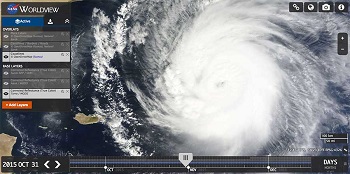 Quickly access satellite imagery of every part of the world in near real-time with NASA’s Earthdata resource. Source: NASA. and distributes scientific data from NASA planetary missions, astronomical observations and laboratory measurements. The agency’s Earthdata site is powered by the Earth Observing System Data and Information System which provides end-to-end capabilities for managing NASA’s Earth science data from various sources – satellites, aircraft, field measurements and various other programs.
For those in pursuit of advances in particle physics, there’s the CERN Open Data portal, which is where one can “explore more than 1 petabyte of open data from particle physics!”
Browse or download information on nearly four million historical specimens in the collection of the London Natural History Museum, as well as scientific sound recordings of the natural world.
Microsoft has released a set of 100,000 questions and answers that artificial intelligence researchers can use in their quest to create systems that can read and answer questions as well as a human. The developers have made MS MARCO (Microsoft Machine Reading Comprehension) datasets available for free to researchers as a means of advancing machine reading.
Donate or browse datasets pertinent to the machine learning community at the University of California-Irvine Machine Learning Repository. The site currently maintain 426 data sets, all viewable through a searchable interface. The collection of databases, domain theories and data generators are used for the  A featured data set in the uCI Machine Learning Repository offers cardiac Single Proton Emission Computed Tomography (SPECT) images. Source: UCIempirical analysis of machine learning algorithms.
Over 20 million records from a variety of large catalogs as well as single contributions, with more on the way, are contained in the Open Library Dump. The software, data and documentation are open in the editable library catalog which expects to build a web page for every book ever published.
Land-based, marine, model, radar, weather balloon, satellite and paleoclimatic are just a few of the types of climate datasets available from the National Centers for Environmental Information, operated by the U.S. National Oceanic and Atmospheric Administration.
Global trends in fossil fuel and renewable energy consumption and trade are tracked by the International Energy Agency. Or head to the World Factbook for information on the history, people, government, economy, energy, geography, communications, transportation, military and transnational issues for 267 world entities. A reference tab includes maps of major world regions, a physical map of the world, a political map of the world, a world oceans map and standard time zones of the world map.
The Open Science Data Cloud provides the scientific community with resources for storing, sharing and analyzing terabyte and petabyte-scale scientific datasets. The data science ecosystem, operated through the Center for Data Intensive Science at University of Chicago in collaboration with the Open Commons Consortium, is a resource for storing, sharing and analyzing terabyte and petabyte-scale scientific datasets.