Polymer Mat "Baits, Hooks and Destroys" Water Pollutants
S. Himmelstein | March 23, 2018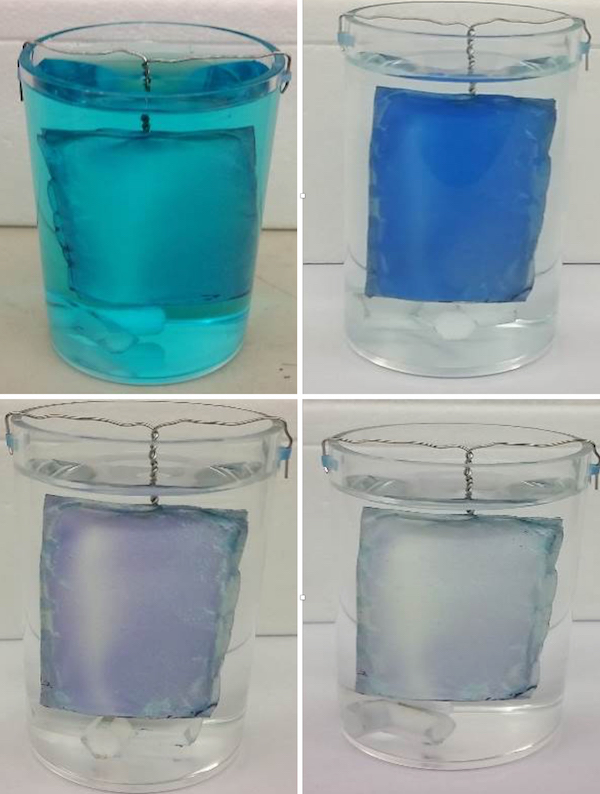 A nanoparticle-infused polymer mat both attracts and destroys pollutants in wastewater or drinking water. A mat, top left, is immersed in water with methylene blue as a contaminant. The contaminant is then absorbed at top right by the mat and, in the bottom images, destroyed by exposure to light. The mat is then ready for reuse. Source: Rice University and Nanotechnology-Enabled Water Treatment Center
Effective removal of water pollutants may require use of the “bait, hook and destroy” strategy. A team of U.S. academic researchers has demonstrated this technique with a polymer mat targeting a pair of endocrine disruptors often present in wastewater systems.
The treatment scheme relies on the use of titanium dioxide, already used in some wastewater treatment systems. The compound is currently combined in slurry form with wastewater, exposed to ultraviolet light to destroy contaminants and then filtered from the water.
The new technique simplifies treatment with highly porous polyvinyl fiber mats that afford sufficient surface area for titanium dioxide to inhabit — and bait — pollutants. The hydrophobic fibers attract hydrophobic contaminants, such as endocrine disruptors. Once bound — or hooked — to the mat, exposure to light activates the photocatalytic titanium dioxide, which produces reactive oxygen species that destroy the contaminants.
Immobilization of the titanium dioxide facilitates its reuse and prevents the photocatalyst from leaching into water systems. The mat, which can also be applied to the treatment of drinking water, can be cleaned and reused, scaled to any size, and its chemistry can be tuned for different pollutants. Energy savings compared to wastewater treatment using slurry are an added benefit of the process. The mat would allow treatment plants to perform pollutant removal and destruction in two discrete steps, which isn’t possible with the slurry.
Researchers from Arizona State University, Yale University and Rice University participated in this development.