Power Density and Stability Gains for Protonic Ceramic Fuel Cells
S. Himmelstein | February 14, 2018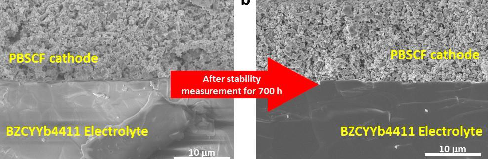 Scanning electron microsopy images of the cathode-electrolyte interface before and after stability measurement for 700 h. Source: Northwestern University
Despite the promise of protonic ceramic fuel cells (PCFCs) contributing to environmentally-sustainable and cost-effective electric power generation, their power outputs have lagged behind predictions based on their high electrolyte conductivities. Northwestern University engineers have overcome PCFC performance and stability challenges by using a high-activity cathode and a chemically stable electrolyte.
A thin dense interlayer film of the double perovskite cathode material was deposited onto the barium cerate electrolyte surface to mitigate contact resistance, an approach that is made possible by the proton permeability of the cathode material. The resulting fuel cell can operate at 500 degrees Celsius with a peak power density of 500 mW cm−2, which translates into a longer service life and less expensive components. The design also offers long-term stability under carbon dioxide. The new electrolyte allows ions to move quickly and, unlike many previous electrolytes, remain stable even when operated for many hundreds of hours.
The researchers next plan to develop scalable manufacturing routes, since realizing the excellent contact between electrode and electrolyte currently requires a costly processing step. A more cost-effective approach will be needed to bolster commercialization efforts. The potential to make the fuel cells reversible, which would transfer electricity back into hydrogen for placement on grid backup, will also be studied.