SurgiBox: A Portable Operating Room
S. Himmelstein | January 17, 2018Performing surgeries in the field or in resource-limited areas poses challenges to health care professionals and 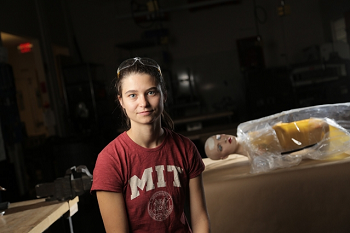 “The idea of SurgiBox is to take the operating room and shrink it down to just the patient’s size. Keeping an entire room clean and surgery-ready requires a lot of resources that many hospitals and surgeons across the globe don’t have.” — MIT graduate student Sally Miller. Source: John Freidahpatients alike. Clean operating theaters are not always available, inviting exposure to bacteria, dust and dirt.
A portable solution is under development by an MIT graduate student. The SurgiBox wraps around the patient and isolates the surgical area with adhesive drapes while allowing access for surgeons to do their work.
The original design had a rectangular frame that sealed to the patient at the armpit and waist. The frame held up a plastic, tent-like enclosure with a fan and high-efficiency particulate air (HEPA) filter that removes 99.997 percent of contaminants. A redesign by the mechanical engineering student eliminated the frames to render SurgiBox more portable and cost-effective. The revised form now consists of an inflatable tent that maintains its structure using the outward pressure from the HEPA-filtered air. The constant air pressure also helps to guarantee that any pathogen is blown away with the current.
This latest iteration of SurgiBox now meets the same germ-proof and blood-proof standard as surgical gowns used by doctors treating Ebola patients. Researchers plan to continue particle testing and to partner with local Boston-area hospitals to test the ergonomics of the design and ensure that it aligns with surgical workflows.