
Oroville Report Blames Systemic Failures
David Wagman | January 05, 2018The Oroville Dam spillway incident was caused by a long-term systemic failure of the California Department of Water Resources (DWR), regulatory and general industry practices to recognize and address inherent spillway design and construction weaknesses, poor bedrock quality, and deteriorated service spillway chute conditions.
The incident cannot reasonably be “blamed” mainly on any one individual, group or organization.
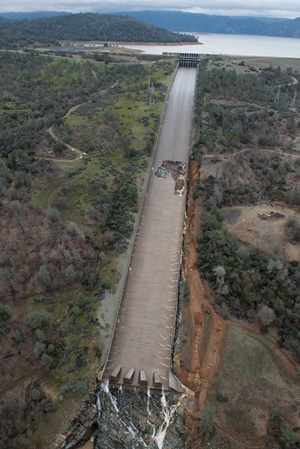 Image shows damage to the spillway. Credit: WikipediaThose are the chief conclusions of a 584-page final report by the Independent Forensic Team assembled to investigate causes of the February 2017 failure of the dam, which is the highest in the United States. (Read "Highest Dam in the U.S. Faces Threat.")
The report says that during service spillway operation on Feb. 7, 2017, water injection through both cracks and joints in the chute slab resulted in uplift forces beneath the slab that exceeded the uplift capacity and structural strength of the slab, at a location along the steep section of the chute.
{Read "Poor Design and Construction Led to Oroville Dam Failure: Report.")
The uplifted slab section exposed the underlying poor quality foundation rock at that location to unexpected severe erosion, resulting in removal of additional slab sections and more erosion.
Responding to the damage to the service spillway chute necessitated difficult risk tradeoffs while the lake continued to rise, the report says. The resulting decisions, made "without a full understanding of relative uncertainties and consequences," allowed the reservoir level to rise above the emergency spillway weir for the first time in the project’s history, leading to severe and rapid erosion downstream of the weir and, ultimately, an evacuation order affecting around 200,000 people.
The report builds on an interim memo from September 2017 that identified physical causes of the incident. The California Department of Water Resources, which is responsible for the dam, says it is in the process of reviewing the report, and intends to incorporate the latest findings into its ongoing efforts.
Agency Review
In May, the state agency began planning for a comprehensive needs assessment of the entire Oroville complex to identify any changes that need to be made to bolster dam safety. An evaluation of the agency's dam safety program is already underway. With the forensic report's findings, organizational issues also may be addressed.
The report says that no single root cause of the Oroville Dam spillway incident exists. It also says there was no simple chain of events that led to the failure of the service spillway chute slab, the subsequent overtopping of the emergency spillway crest structure and the necessity of the evacuation order.
"Rather, the incident was caused by a complex interaction of relatively common physical, human, organizational and industry factors, starting with the design of the project and continuing until the incident."
The report finds that the inherent vulnerability of the service spillway design and as-constructed conditions reflect "lack of proper modification of the design to fit the site conditions." Almost immediately after construction, the concrete chute slab cracked above and along underdrain pipes, and high underdrain flows were observed. The slab cracking and underdrain flows, although originally thought of as unusual, were quickly deemed to be “normal,” and as simply requiring on-going repairs. The report finds that repeated repairs were ineffective and possibly detrimental.
Lessons Learned
The report outlines broad lessons to be learned by the dam safety community:
• In order to ensure the safe management of water retention and conveyance structures, dam owners must develop and maintain mature dam safety management programs which are based on a strong “top-down” dam safety culture. There should be one executive specifically charged with overall responsibility for dam safety, and this executive should be fully aware of dam safety concerns and prioritizations through direct and regular reporting from a designated dam safety professional, to ensure that “the balance is right” in terms of the organization’s priorities.
• More frequent physical inspections are not always sufficient to identify risks and manage safety.
• Periodic comprehensive reviews of original design and construction and subsequent performance are imperative. These reviews should be based on complete records and need to be more in-depth than periodic general reviews, such as the current FERC-mandated five-year reviews.
• Appurtenant structures associated with dams, such as spillways, outlet works, power plants and so on, must be given attention by qualified individuals. This attention should be commensurate with the risks that the facilities pose to the public, the environment, and dam owners, including risks associated with events which may not result in uncontrolled release of reservoirs but are still highly consequential.
• Shortcomings of the current Potential Failure Mode Analysis (PFMA) processes in dealing with complex systems must be recognized and addressed. A critical review of these processes in dam safety practice is warranted, comparing their strengths and weaknesses with risk assessment processes used in other industries worldwide and by other federal agencies. Evolution of “best practice” must continue by supplementing current practice with new approaches, as appropriate.
• Compliance with regulatory requirements is not sufficient to manage risk and meet dam owners’ legal and ethical responsibilities.
The forensic team included John W. France, PE, D.GE, D.WRE – Team Leader and Geotechnical Engineer; Irfan A. Alvi, PE – Hydraulic Structures Engineer and Human Factors Specialist; Peter A. Dickson, PhD, PG – Engineering Geologist; Henry T. Falvey, Dr.-Ing, Hon.D.WRE – Hydraulic Engineer; Stephen J. Rigbey – Director, Dam Safety at BC Hydro, and Geological Engineer; John Trojanowski, PE – Hydraulic Structures Engineer.

This entire report is junk!
Typical waste of money. Over 500 pages that says the dam was not properly designed, constructed and MAINTAINED!
That's it.
It was known to be flawed, but it was cheaper to add band aides than repair the spillway properly. $$$$
The flaws will, no doubt, remain in place because of$$$$.
The country's infrastructure is falling apart everywhere because politicians refuse to properly fund upkeep. It's more important to give tax breaks to big business, who pay their real wages (bribes) than fix what's wrong with the roads, bridges, dams and the rest.
Lip service will be paid until the next disaster happens and then we'll get another 500-1,000 page useless report that brings head shaking and tisk tisking again and no real action will be taken.
In reply to #1
I mostly agree with you. It is typical mismanagement/mishan
In proper maintenance of structures such as dams, every control has to be preventive maintained on a schedule, with the preemptive assumption that a part is in a failed condition at the beginning of the inspection/test, until such time as the workers prove that it does operate correctly, and then they sign off on it. Two sets of eyes, not just one.
It is one thing to engineer such a structure, another to actually build it, and another to keep the construction on such scales on time and on budget. Over time, things have this pesky tendency to corrode or wear out. This is why maintenance has to be a service of vigilance.
The money needs to go to the workers that keep the thing operable, and the personnel that keep the work force on task. Upper level management seems to be getting to spend too much time at the trough, when they should be making sure that the correct protocols are in place, and that the key personnel are on the job, taking care of business.
"It was known to be flawed." This is where the flawed reasoning always seems to enter the picture. Rather than spend $X to correct the problem for Y years, $z is spent n times over Y/10 years (1/10 of the time it would have been good for), such that in Y years, z*n*10> $X, by a large factor, but nobody cares apparently since this was not spent all at once.
This is where bean counter style managers, and politicians need to get out of the way, and let the real men and women get to work on fixing our infrastructure.
Infrastructure always pays back far more than it costs in goods and services provided/transported
We did not have Interstate Highways until the system was begun under Ike Eisenhower's leadership. This was at least part of the secret sauce that allowed America to begin to be far more prosperous than ever before, and keep all the WWII veterans employed.
This is something we seldom see any more: Large scale engineering, that benefits the entire nation, not just one or two slush funds with shaky connections to politicians.
From the picture, it is clear that the water enters the top of the chute at whatever velocity. It then inceases down the relatively flat portion of the chute. Said water increases velocity going over the top part of the chute slope. The water continues to increase velocity all the way down the chute to its end at nearly maximum velocity, throuh the lowest baffles. Why did the the chute not fail more near the point of maximum velocity? It was because there was a weaker slab portion higher up the slope that failed first. Why was it weaker higher up? It was because there was more water intrusion at that mid-level location. Where did that water intrusion come from? It came through inadequately compacted subgrade fill along the side trench. Side trench water water flow was more easily able to hydraulically wash away the fill material enough underneath the chute slope slab to find the weakest point of support of the chule slab. Continuous erosion then caused a slight differential settlement of the chute floor slab. Continuous water flowed over the subsequently cracking chute floor slab, thereby causing the primary chute failure...