
A Bottom-Up Analysis of US Livestock Methane Emissions
S. Himmelstein | December 03, 2017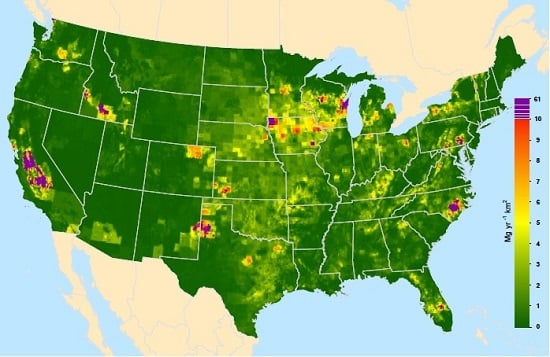 The researchers estimated methane emissions using a "gridded" approach, dividing the U.S. into 0.1- by 0.1-degree geographic information system (GIS) units. The study pegged total U.S. livestock methane emissions of 19.6 billion pounds per year. This map shows where they are coming from. Source: Penn State
According to the U.S. Environmental Protection Agency (EPA), the livestock industry is the second-biggest methane emitter in the U.S., accounting for 36 percent of the total. The gas evolves from the microbial fermentation that occurs in the animals’ stomachs, resulting in digestion-related (enteric) emissions, and from fermentation in their manure. The total amount depends on the type of animal, what the animals eat and how their manure is stored. For example, cattle that mostly consume grain-based feed release significantly less enteric methane than cattle that graze on pasture.
Current estimates of total livestock methane emissions may rely on outdated emission factors and do not fully consider feed intake and differences in animal diets, or the facilities used to store manure. These data gaps lead to large uncertainties in methane emission figures.
Top-down emissions estimates involve monitoring atmospheric methane concentrations by satellites or from air samples collected at high altitude by planes, and using models to estimate the sources of emissions. Bottom-up estimates take into account livestock populations and animal emission factors. The latter approach was used by University of Pennsylvania researchers to estimate enteric methane emissions for cattle and manure methane emissions for cattle, swine and poultry for the contiguous U.S.
The country was divided into 0.1 by 0.1-degree geographic information system (GIS) units, which created cells from 31 square miles in the northern U.S. to 42 square miles in the southern part of the country.
The team analyzed feed intake data for cattle, as well as manure storage practices for cattle, pigs and poultry, at the county and state levels. The resulting estimates for methane emissions by location varied widely from numbers currently reported by inventories such as the European Emission Database for Global Atmospheric Research (EDGAR). For example, the combined enteric and manure methane emissions from livestock in Texas and California were 36 percent less and 100 percent greater, respectively, than estimates by EDGAR. Based on their data, the researchers say that results from studies that use inaccurate distribution inventories to determine emissions sources should be cautiously interpreted.
Total U.S. livestock methane emissions of 19.6 billion pounds per year were estimated, but the researchers acknowledge that uncertainty surrounding this figure is high.
"Our analysis showed that the EPA’s estimates are close to reality, but there is a discrepancy in the spatial distribution of emissions. And, our research revealed a great discrepancy with global models such as the EDGAR inventory,” said Alex Hristov, professor of dairy nutrition.


Catchy title.
Help is on the way.
This Is How You Turn Cow Flatulence Into Energy | Big Think
Fiscalini Farms Methane Capture Project - The Carbon Neutral ...
Two Arizona dairies produce methane power - AZCentral.com
For my money, cleaning up all the well leaks in California and elsewhere and outlawing gas flaring are the more attainable short term goals.
Given the current political environment, maybe Hell freezing over is more likely.
Then, there also the two ton carbon/methane gorilla buried in the Alaskan perma-frost (and elsewhere) that is being melted by, dare I say, Global Warming!
My comment is only relevant if understood as an answer to the problem, and folk will need to become educated about Biochar to fully understand it.
There has now been huge success with feeding cows charcoal, 200 to 400 GRAMS/day, (mixed with their molasses) the charcoal helps the digestion, reduces infection and is turned into Biochar (actually enlivened biochar) by the cow, then pooped out and buried by Dung Beetles, leading to healthier cows with higher stocking rates, and rebuilding the impoverished soil, or vastly improving good soil - those farmers using that technique should get the dividend, twould perhaps pay for the charcoal, a dividend would be appropriate as farmers are traditionally conservative and hesitant to spend money.
Much land in Australia is very difficult to farm except by running animals on it, and as very little charcoal is lost by this process, the farmer would know exactly how much charcoal he has put into the soil through his cows.
Threre are 28.5 Million cows in Australia, more than people, if they each get app 1/3rd of a kilo that is 9.5 million kilos per day, 3467.5 million Kgs per year, - in America there are 98.4 million, - between 1,3 and 1.5 Billion cows on the Earth, - do the sums, and charcoal/carbon is traditionally taken by humans for flatulence, - virtually removes methane farting from cows too.
an institute in Germany has done some good research, - the Ithaka foundation, http://www.ithaka-in
Again you see the changes coming up from individuals and groups, not imposed by politicians who typically lead by watching where every one is running and then pretending to be at the front.
https://www.youtube.
Of course I think the research you are doing is important, hoping that suggesting an antidote to the difficulties identified is helpful.
While methane is odorless, an up close and personal experience with it and its more odiferous bowel gasses may be had if one is traveling I-40 in the vicinity of the TX-NM border, as I was many years ago late at night when I came to a halt for over an hour due to a major wreck on the roadway. I can confirm for this location that the map of livestock methane emissions is dead on and probably corresponds to a pool of health issues in the local human population due to their lifetime (short as it may be) exposure to the noxious gases in the air they breathe.