First Oil Produced from North Atlantic Field
David Wagman | November 29, 2017ExxonMobil Canada says that the Hebron platform produced its first oil on November 27. The oil was extracted from the Hebron field in the Jeanne d’Arc Basin, some 350 kilometers (217 miles) off of Newfoundland and Labrador.
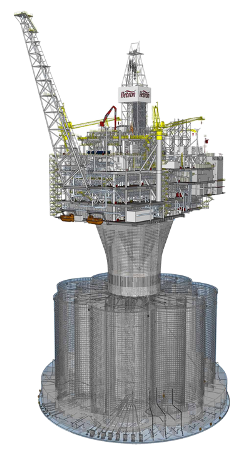 Hebron's topsides and gravity based structure. Credit: HebronThe project was sanctioned in December 2012. The completed platform was towed to the field in early June 2017, following its construction at Bull Arm, Newfoundland. The platform was then set down, and drilling began within 30 days.
 The field was discovered in 1980 and is expected to produce more than 700 million barrels of recoverable resources. At peak rates, the Hebron platform will be able to produce up to 150,000 barrels of oil per day. It has a storage capacity of 1.2 million barrels of oil.
ExxonMobil Canada Properties (35.5 percent) is the operator of the Hebron project. Its partners are Chevron Canada Limited (29.6 percent), Suncor Energy Inc. (21 percent), Statoil Canada Ltd. (9 percent) and Nalcor Energy-Oil and Gas Inc. (4.9 percent).
The water depth at the Hebron field is 93 meters (mean sea level), or around 300 feet. The field is being developed using a stand-alone concrete gravity based structure (GBS). The GBS consists of a reinforced concrete structure designed to withstand sea ice, icebergs, along with meteorological and oceanographic conditions.
Fabrication of the derrick equipment set and the utilities/process module of the topsides is occurring in Ulsan, Korea.
The project includes offshore surveys, engineering, procurement, fabrication, construction, installation, commissioning, development drilling, production, operations and maintenance and decommissioning.
Project details include the following:
Gravity Based Structure Key Quantities
- Height of GBS - 122 meters
- Diameter of GBS base - 130 meters
- Shaft diameter - 35 meters
- Concrete volume - 132,000 cubic meters
- Rebar - (density 300 kg/m3) approx. 40,000 tonnes
- Post-tensioning steel - 3,400 tonnes
- Steel skirts - 400 tonnes
- Mechanical outfitting - 8,000 tonnes (piping systems & structural steel)
- Well slots - 52
Topsides Key Metrics
- Length of Topsides - 183 meters
- Width of Topsides - 75 meters (excluding helideck)
- Height of Topsides - 113 meters
- Topsides operating weight - 65,000 tonnes
- Crude oil production - 150,000 barrels/day (at peak)
- Water production - 200-350 thousands of barrels/day (kbd)
- Water injection - 270-470 thousands of barrels/day (kbd)
- Gas handling - 215-300 million standard cubic feet/day
- Accommodations - Persons On Board (POB) - 220
Offshore Loading System Key Metrics
- Total crude handling capability: 5,400 cubic meters/hr
- Pipeline: 24-inch, 6 km concrete coated
- Bases: 2 redundant offshore loading stations each consisting of an anchor assembly and hose system
- Anchor assembly weight: 140 metric tonnes
- Hoses system: 15 x 12m hose lengths, 20-inch diameter