
US Army Janus program selects 5 nuclear microreactors
Peter Brown | September 02, 2026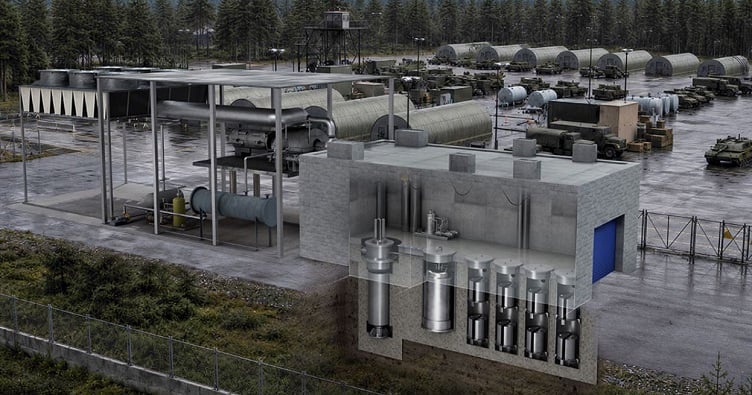 An artist rendering of General Atomics’ nuclear microreactor that will be deployed at Fort Hood, Texas as part of the U.S. Army’s Janus Program. Source: General Atomics
The U.S. Army’s Janus Program has selected five nuclear energy vendors and five initial locations to deploy nuclear microreactors for secure nuclear power in an event where the electric grid is compromised.
The Department of War Innovation Unit (DIU) is awarding up to a combined $2.2 billion to own, construct and operate nuclear microreactors on military installations. Combined with private sector funding, the U.S. Army plans to deploy more than 20 total nuclear microreactors built and operated across Department of War installations.
The five vendors and locations include:
- Antares Nuclear, Inc. in Fort Bragg, North Carolina
- BWXT Advanced Technologies, LLC in Fort Campbell, Kentucky
- General Atomics Electromagnetic Systems in Fort Hood, Texas
- Radiant Industries, Inc. in Fort Benning, Georgia
- Westinghouse Government Services in Fort Drum, New York
“The Army is leading the nation in its return to nuclear preeminence via the Janus Program,” said Jason Craft, Janus Program manager. “Our selected industry awardees represent the most viable technologies to achieve this capability, setting conditions for both installation energy resilience and operational energy solutions.”
After a year-long evaluation, the companies chosen by the Janus Program will install nuclear energy storage technologies on other service installations across the Department of War. Other Army and other service sites will be announced later, the U.S. Army said.
The program is part of the Executive Order 14299 signed by President Trump for operation of microreactors on a military installation. That order called on the federal U.S. government to accelerate the development, deployment and export of “advanced nuclear technologies to bolster readiness and enhance American technological superiority.”
According to the U.S. Army, the prototype reactors will be contractor-owned and operated.
GA-TES
General Atomics’ Tactical Energy System (GA-TES) is a microreactor that combines the vendor’s uranium-zirconium hydride (UZrH) fuel technology with pump-free natural-circulation cooling. This type of cooling allows the microreactor to provide power for defense infrastructure without dependence on large cooling-water infrastructure, the company said.
The microreactor continues General Atomics’ strategy of integrating nuclear technologies and materials with power and energy systems for national security missions, General Atomics said.
The reactor is a liquid-metal-cooled system with a baseline net output of about 5 megawatts electric (Mwe) and an architecture scalable to about 20 MWe. It is designed for remote, off-grid and extreme environments with a lifespan of 40 years. It is also a modular architecture that supports transport and deployment by truck or rail.
“Passive safety and operational simplicity are fundamental to our Tactical Energy System design,” said Christina Back, vice president of General Atomics Electromagnetic Systems (GA-EMS) Nuclear Technologies and Materials. “Self-protecting UZrH fuel and pump-free natural-circulation cooling reduce reliance on active systems and operator intervention, while provide flexibility to meet evolving defense energy requirements.”
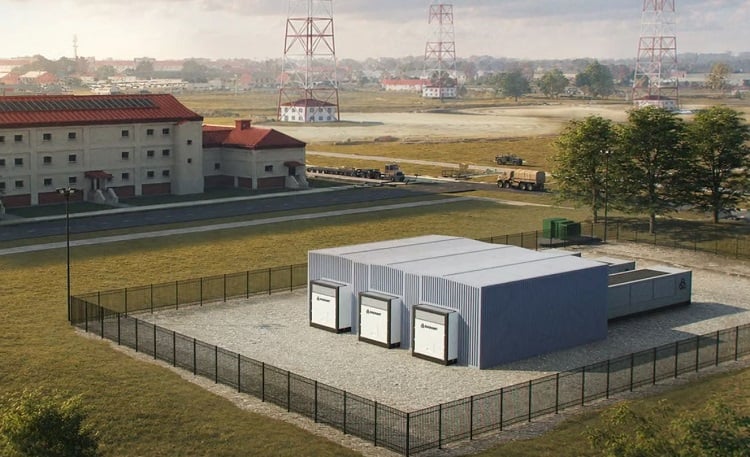 An artist rendering of the Radiant’s Kaleidos nuclear microreactors that will be deployed at Fort Benning, Georgia, as part of the nuclear electric grid development on U.S. Army military installations. Source: Radiant
Kaleidos
Billed as the only plug-in ready, transportable commercial nuclear microreactors, Radiant received an award from the U.S. Army for up to $750 million to develop and deploy 15 Kaleidos nuclear microreactors through the Janus program. The microreactors will be installed at the Fort Benning, Georgia, military installation.
The Kaleidos microreactor is a 1-megawatt nuclear microreactor that can be transported by land, sea or air and deployed directly at customers sites. The plug-in ready reactor provides up to 5 years of power before refueling and is engineering with a 20-year operating lifecycle, Radiant said.
The microreactor requires no cooling water and is already sealed and fueled that can be plugged-in immediately without having to bury it in the ground. Radiant manages the fueling, refueling and spent-fuel storage at its own facilities.
“The U.S. Army is a savvy customer,” said Tori Shivanandan, president and chief operating officer of Radiant. “They have the world’s top nuclear experts and know what to look for in a partner. The numbers tell the story. This award shows confidence in Radiant’s product and ability to manufacture, deploy, and safely operate nuclear microreactors for the American military."




The word "advanced" is used loosely in describing reactor operating systems. Do they mean Gen III using water cooled thermal technology; or do they mean a Gen IV (fast) reactor using a fast neutron spectrum? Since at least one was liquid metal cooled, at least that one is a fast reactor. I hope all are, because fast reactors are much more efficient in the use of uranium.
In reply to #1
Looked into this a little more to find out a bit more about the energy reactions. It appears they are neither Gen III or Gen IV but are a new design that run on thermal neutron spectrum. All but the General Atomics microreactor uses TRISO particle fuel, General Atomics uses the UZrH fuel.