MIT Students Create the 'Personal Thermostat'
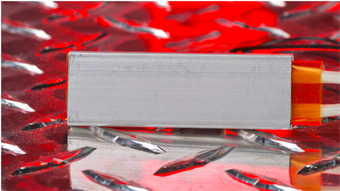
Abe Michelen | September 29, 2017 The Embr Wave personal thermostat. Source: Embr Labs
Unless an individual is wearing special clothing, body temperature is normally tuned to environmental temperature. This environment sets their thermal condition, but not necessarily their perceived thermal comfort.
Four MIT students have responded by creating a wearable that will make harsh climates more bearable. The so-called personal thermostat wristband will be released next year by the MIT spinoff startup company Embr Labs.
The Embr Wave—or Wristify—is built with a flat aluminum top that allows the user to adjust temperature comfort and provide themselves with cooling or warming by changing a display from red to blue. The wristband contains a thermoelectric device that provides the desired temperature to the wrist when electrical current runs through it. When heating is desired, the electric current entering the plate produces heat waves directly onto the wrist. When cooling, the device dissipates heat with the aid of the aluminum plate. The gadget works because the wrist is one of the most sensitive parts of the body.
“The aim is to make ‘temperature personal’,” says Embr Labs co-founder David Cohen-Tanugi, Ph.D. “We want people who are often uncomfortable and have little control over temperature to have more control and more relief in everyday life."
The startup company is now taking orders and will likely ship the first devices early next year. Co-founders Cohen-Tanugi, Sam Shames and Matthew Smith, Ph.D., came up with the idea in 2013. “We’re excited to finally say ‘yes’ to all the people who have been asking us for years, ‘Can I buy this yet?’” Shames say.
Besides providing temperature comfort to individuals, the device can help save energy use in buildings. Studies made at the University of California at Berkeley show that if a building’s thermostat neutral zone—the range before air conditioning or heating kicks off—is extended by one degree, energy consumption is reduced by 10 percent. Further changes are also impacted by a factor of 10.
Embr Labs believes that if the wristband users feel comfortable enough, it is possible to extend the neutral zone in buildings one to two degrees with the consequent energy savings. They secured a National Science Foundation grant to test this idea.
The Idea
The idea came to the students one afternoon when they were working in the materials lab at MIT, and the air conditioning was so high that they couldn’t do anything useful. “We were using all this energy cooling this lab space that was mostly empty, and we were actually uncomfortably cold,” Shames says.
The team wondered: “What if we could heat and cool people directly to make everyone more comfortable and save energy?”
The students thought about the concept of thermal comfort, which comes down to unique localized thermal sensations in parts of the body. For example, toes or fingers feel colder than the rest of the body in cold weather and the face or hands may feel warmer in hot weather. To increase thermal comfort in winter, many people rub their hands together. The friction makes the person's hands warmer, and he or she feels better all over the body.
The reason localized sensations make people more comfortable has do with the fact that the human body responds to thermal sensations produced in the skin. Once the region of the brain that controls pressure and thermoregulation detects these sensations, it triggers a response to balance the body and make it feel more comfortable.
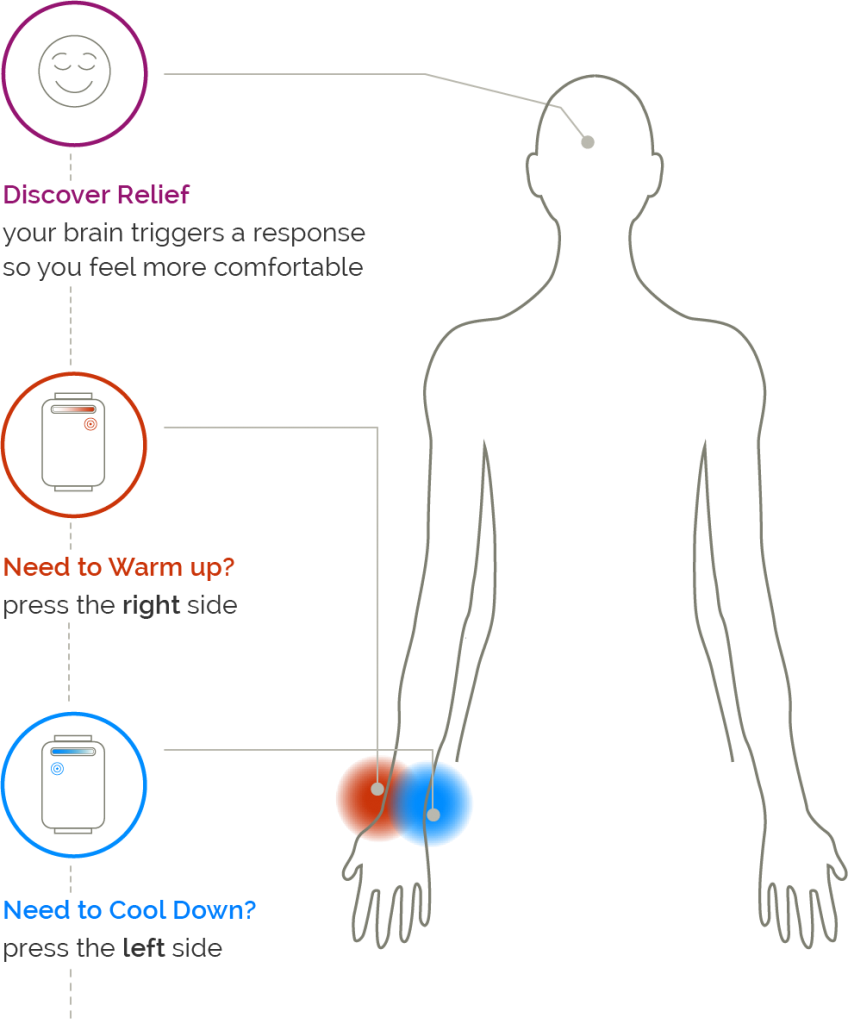 Source: Embr Labs
The Design
The team, after consulting mentors in the Material Science and Engineering departments, environmental engineering professors and experts in the physiology and psychology of temperature, they decided to use the wrist as the spot to provide thermal comfort. They had to consider many variables in engineering and human physiology and psychology to reach the final design.
A key innovation was the team's discovery that by delivering heat in rhythmic waves of temperature, it stops the user from acclimatizing to one sensation. Instead, by rhythmically delivering the heat, the users will experience a smooth transition to a new temperature and thermal comfort.
“We had to go from power electronics and mechanical engineering to physiology and psychology, in order to build a framework of dynamic heat rhythms that would pack as much temperature relief as possible in a sleek wristband,” Cohen-Tanugi says. “It was a whole new technological challenge.”
A more detail description of the gadget can be found at Embr's website.