These wearable patches could keep you both cool and warm
David Wagman | June 10, 2019Engineers at the University of California San Diego have developed a wearable patch that they say could provide personalized cooling and heating.
The soft, stretchy patch cools or warms a user’s skin to a comfortable temperature and keeps it there as the ambient temperature changes. The patch is powered by a flexible, stretchable battery pack and can be embedded in clothing.
Researchers say that wearing it could help save energy on air conditioning and heating.
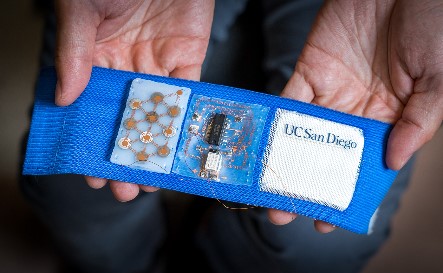 Armband embedded with flexible battery pack (left), stretchable circuit (center), and cooling/heating patch (right). Source: UC San DiegoThe device is at the proof-of-concept stage and could save energy by making it less likely that a user will adjust the thermostat. Keeping a building’s set temperature 12 degrees higher during the summer, for example, could cut cooling costs by about 70%, the researchers said.
Their research work is published in the journal Science Advances.
Not a fan
A variety of personal cooling and heating devices are already on the market, but typically are not convenient to wear or carry. Some use a fan, and some need to be soaked or filled with fluids like water.
The researchers built the patch by taking small pillars of thermoelectric materials (made of bismuth telluride alloys), soldering them to thin copper electrode strips, and sandwiching them between two elastomer sheets. The sheets are specially engineered to conduct heat while being soft and stretchy. Researchers created the sheets by mixing a rubber material called Ecoflex with aluminum nitride powder, a material with high thermal conductivity. The device physically cools or heats the skin to a temperature that the wearer chooses.
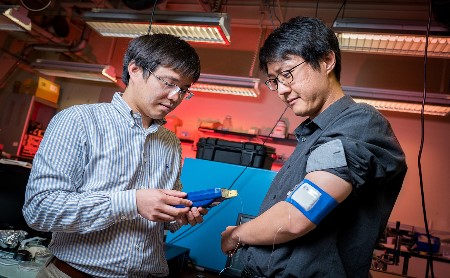 Renkun Chen (left), UC San Diego professor of mechanical and aerospace engineering, measures the temperature of the prototype cooling/heating system worn by Sahngki Hong (right), the study's first author. Source: UC San DiegoThe patch uses an electric current to move heat from one elastomer sheet to the other. As the current flows across the bismuth telluride pillars, it drives heat along with it, causing one side of the patch to heat up and the other to cool down.
The patch is powered by a flexible battery pack. It is made of an array of coin cells all connected by spring-shaped copper wires and embedded in a stretchable material. The system also includes a stretchable circuit board.
Hot under the collar
“You could place this on spots that tend to warm up or cool down faster than the rest of the body, such as the back, neck, feet or arms, in order to stay comfortable when it gets too hot or cold,” said first author Sahngki Hong, a UC San Diego mechanical engineering alumnus who worked on the project as a Ph.D. student.
The researchers embedded a prototype of the patch into a mesh armband and tested it on a male subject. Tests were performed in a temperature-controlled environment. In two minutes, the patch cooled the tester’s skin to a set temperature of 89.6° F. It kept the tester’s skin at that temperature as the ambient temperature was varied between 71.6° F and 96.8° F.
One patch measures 5 cm × 5 cm in size and uses up to 0.2 W worth of power. The research team estimates that it would take 144 patches to create a cooling vest. They said this would use about 26 W total to keep an individual cool on an average hot day (during extreme heat, estimated power use would climb up to 80 W, which is about how much a laptop uses). By comparison, a conventional air conditioning system uses tens of kilowatts to cool down an entire office.
The team is now working on patches that could be built into a prototype cooling and heating vest. They hope to commercialize the technology in a few years.