Faster Than a Speeding Bullet Train
Eric Olson | September 18, 2017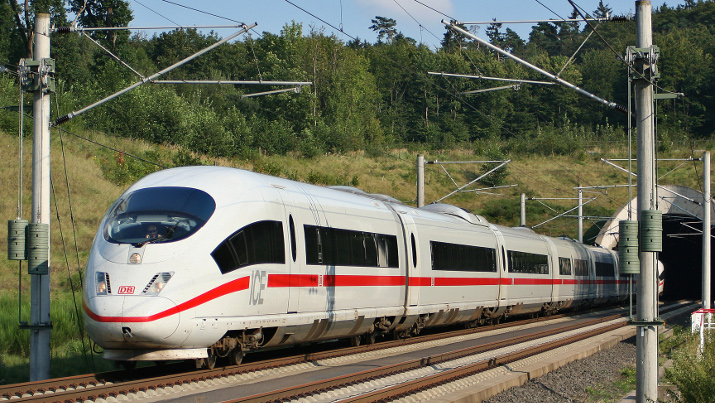 An ICE 3 high speed train on the Frankfurt-Cologne high speed rail line, near the Oberhaider Wald Tunnel. Credit: Wikipedia / CC BY-SA 3.0
Traveling at speeds up to 320 kilometers per hour, high-speed trains are a quick way to get around. Every year 1.6 billion passengers choose high-speed rail as their mode of transportation, traveling along nearly 30,000 kilometers of high-speed rail as of April 2015, according to the International Union of Railways (UIC). Especially effective between large urban centers located relatively close to each other, high-speed rail is a safe and reliable form of transport that can reduce travel times and relieve congestion on highways and at airports.
High-speed rail compares favorably to other modes of transportation, in particular air travel, over average distances of less than 700 to 800 kilometers. Travel by high-speed rail is faster overall when considering the ride to the station or airport and time spent in terminals. It takes less time to travel to rail stations centrally located in the city compared to airports on the periphery. In addition, there is often a perception that rail travelers suffer from less inconvenience from security checks and precautions. Rail travel also has less environmental impact than travel by plane, with lower carbon dioxide emissions per passenger.
With all of these benefits, it’s not surprising that regional high speed rail service has been shown to be highly competitive with air travel. In Spain, the market share of air transport versus train service between Madrid and Seville was 67 percent to 33 percent in 1991. After the introduction of the Alta Velocidad Espanola (AVE) high-speed rail service, train service dominated the market with an 83.6 percent market share in 2000.
Operating Speeds
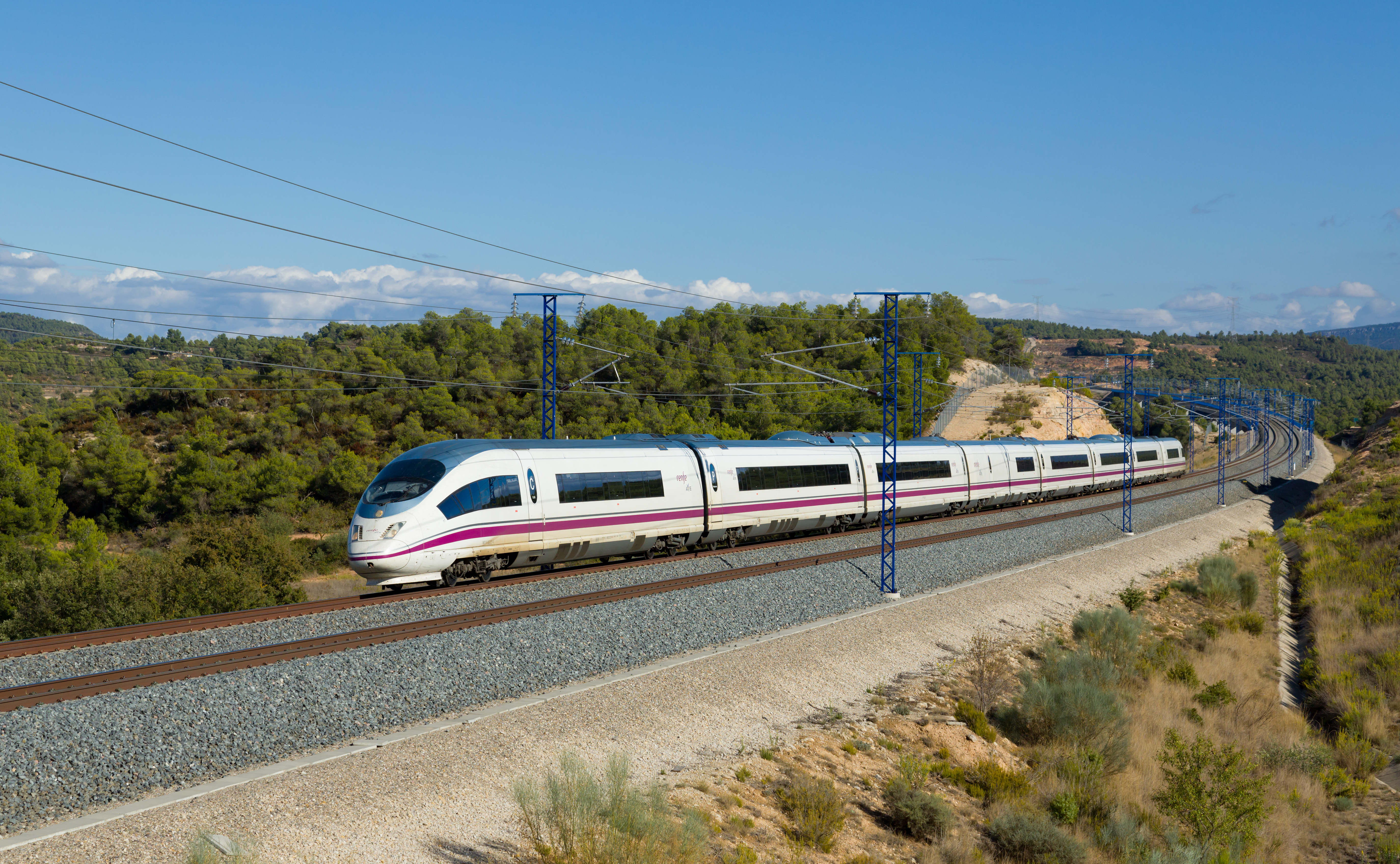 Class 103 high speed train on AVE’s Barcelona-Madrid line. Credit: Wikipedia / CC BY-SA 3.0
The operational speed of high speed rail is between 200 to 300 kilometers per hour and can be categorized among two technologies in use today: improved conventional rail and exclusive high speed tracks. Improved conventional rail runs at speeds of kilometers per hour on existing lines shared with passenger and freight services. Tracks dedicated to high speed rail are capable of higher operating speeds of 240 to 300 kilometers per hour. These tracks offer exclusive passenger service. Separate freight service, meanwhile, benefits from operational efficiencies gained by having exclusive access to lines previously shared with passenger trains.
Maximum operating speeds of high speed rail have increased steadily since the 1960s as technology has improved. Taking into account limiting factors on the operating speed of high speed rail, such as aerodynamic drag, the optimal speed of operation is around 500 to 550 kilometers per hour. Most high speed trains operate below that speed, leaving much room for improvement in the future. The maximum speed for high speed rail service actively generating revenue is 320 kilometers per hour. The current record for wheeled high speed rail travel is 574.8 kilometers per hour set in April 2007 by a special train on the French TGV East line.
Technical Requirements
Compared to conventional rail, high-speed rail has more exacting technical requirements. High-speed track must be fabricated and installed according to tight dimensional tolerances. Sharp twists and turns in the track cannot be handled by trains travelling at high speeds. High-speed trains must be accommodated by large radius curves in the track. A minimum curve radius of 3,500 meters is recommended for trains travelling at 200 kilometers per hour, and 7,000 meters is needed for speeds of 300 kilometers per hour, according to the UIC.
Track must also be laid upon relatively flat land. A gradient of 35 to 40 millimeters per meter is recommended for track handling passenger traffic, with only 12 to 15 millimeters per meter recommended for mixed freight and passenger traffic. In addition, broad track center distances are required: four meters for trains travelling at 200 kilometers per hour, and four and one-half or five meters for speeds of 300 kilometers per hour.
High-speed trains typically have limited axle loads (11 to 17 tons for 300 kilometers per hour service) and high traction power (11 to 24 kilowatts per ton). Furthermore, special catenary and power supply systems are required for high-speed rail, as well as on-board signaling. At high speeds, conductors might not have enough time to respond to trackside signals.
 Slab track on the Nürnberg–Ingolstadt high speed line. Credit: Wikipedia / CC BY-SA 2.0
The European rail system is deploying a complete rail management system known as the European Rail Traffic Management System (ERTMS) to enhance the safety and interoperability of train protection systems. The ERTMS is comprised of the European Train Control System (ETCS), Global System for Mobile Communications-Railways (GSM-R), and a traffic management layer with automatic centralized traffic control. The ETCS continuously monitors train motion with the capability to stop trains if they are travelling above the permitted speed for a given line section.
High-speed trains have several complementary braking systems, including mechanical friction brakes and electrodynamic eddy current brakes. The usual braking distance required to stop a train travelling at 200 kilometers per hour is 1.9 kilometers. That distance increases to 6.7 kilometers for a train travelling at 350 kilometers per hour.
Wheeled high-speed rail runs along either ballasted track or slab track. Ballasted track consists of metal rail mounted on wooden sleepers laying on a bed of crushed rock ballast. With slab track, a concrete slab is used instead of crushed rock. Slab track is more expensive than ballasted track but requires less maintenance.
Maglev
Magnetically levitated trains, or maglev trains, use an alternative high speed rail technology. There are two types of maglev technology: electromagnetic suspension (EMS) and electrodynamic suspension (EDS). In EMS systems, the train floats on magnetic fields generated by powerful magnets mounted in the track and base of the train. Magnetic fields changing polarity alternately exert pushing and pulling forces to propel the train along the track.
EDS systems operate on a similar principle, except the levitation and propulsion is achieved by an induced magnetic field in wires along the track. Japan Railway’s experimental maglev train broke the world speed record in April 2015, travelling at a top speed of 603 kilometers per hour.
The hyperloop concept involves capsules floating on maglev tracks or air bearings and propelled by linear induction motors through a tube partially evacuated of air. The lack of track friction and air resistance allows the train pods to glide at high speeds to their destinations. An open source design for the hyperloop concept was released by Elon Musk’s Tesla and SpaceX in August 2013. A range of private companies are working to advance and deploy hyperloop technology around the world, including Hyperloop One, Hyperloop Transportation Technologies, and TransPod.
High-speed rail infrastructure has significant construction, operation, and maintenance costs, often requiring public subsidies to complete projects. But the mode of transportation offers substantial benefits in the form of faster travel times, relieved congestion, and reduced environmental impact that make it worth the expense.