Seat and Guide Materials Keep Engine Valves Cooler
S. Himmelstein | August 14, 2017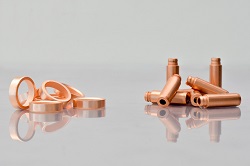 Source: Federal-Mogul Powertrain
Federal-Mogul Powertrain has developed new materials for valve seats and guides with improved thermal conductivity. High thermal conductivity (HTC) materials and a thermal interface material (TIM) coating reduce valve head temperatures by up to 70° C, allowing improved combustion and lower emissions.
The seat insert is the primary heat path from the valve head into the cylinder head cooling jacket. By conducting more heat away from the valve head, the new seat materials reduce the temperature in the hottest part of the combustion chamber and lower the gas temperature at the end of the compression stroke.
The TIM coating improves the heat transfer across the boundary between the seat insert or guide and the cylinder head by filling the interstitial spaces between the irregularities of the opposing surfaces. This eliminates the minute air pockets that normally interrupt the heat path and improves the conformability against the cylinder head surface.
Evaluations conducted at Federal-Mogul Powertrain's Burscheid, Germany, test center on state-of-the-art, highly rated turbocharged gasoline engines with direct injection demonstrated the effectiveness of the new materials. A combination of HTC and TIM technologies reduced peak inlet valve head temperatures by between 26 and 32° C.
The improvement in exhaust valve head temperatures was even more marked: on a solid valve the peak was reduced by up to 70° C and on a hollow, sodium-filled valve, by up to 67° C. Though primarily intended for highly rated gasoline applications, the materials could be equally beneficial for exhaust valve seats and guides on high performance turbo diesels and for heavy-duty diesel engines.