Scientists Develop Algorithm That Could Create More Reliable Wind Power
Siobhan Treacy | June 06, 2017Wind has been a huge player in renewable energy since the 1880s. Wind power has gained popularity due to the search for a reliable alternative energy source. But that is the thing about wind, it’s not reliable. Wind is unpredictable unless you are an experienced meteorologist. Wind doesn’t always blow where it needs to, and this is especially important with renewable energy. A team of scientists from University of Connecticut and ABB Inc. has developed a new two-prong approach that ensures wind power won’t die down as a renewable energy source.
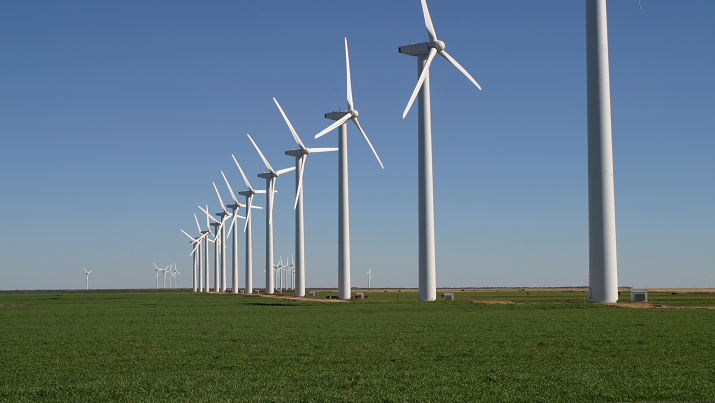 Wind turbine farm in Texas (Wikicommons, Leaflet)
"Wind farms are often located in remote locations with high-output wind resources, far from cities, where electricity demand is high," wrote Bing Yan, an assistant research professor in the department of electrical and computer engineering at the University of Connecticut and an author on the study. "In this paper, our idea is to pair each remote wind farm with a sufficiently large and not necessarily co-located conventional unit."
Yan’s team uses an algorithm that virtually relocates traditional power generation units to a wind counterpart. This computationally reduces distance, so there is less of demand for expensive batteries to store reserve power.
"The basic idea is to divide power generation of conventional units into two components," wrote Yan. The first component of the algorithm predicts future wind movements, based only on the current states, instead of using previous wind states. The second component of the algorithm provides limitations based on global information for extreme wind.
The approach produces power that is consistent with expected wind behavior and can adjust as needed when the wind falls short or exceeds what is expected. The two units account for areas with high power demand, even if they are not close to each other.
Researchers tested this model using a simulation with paired conventional units and wind farms. Yan says that the result of the simulation demonstrates the effectiveness of the approach, accuracy, and efficiency.
Yan’s team is working to build on the research from their paper on this algorithm. One project is developing an urban distribution for smart cities. Yan is studying how to integrate renewable resources to be the core components of this new network.
The paper on this algorithm was published in IEEE/CAA Journal of Automatica Sinica (JAS) and can be found here.