Replacing Bridge Using Novel Technology
Marie Donlon | May 25, 2017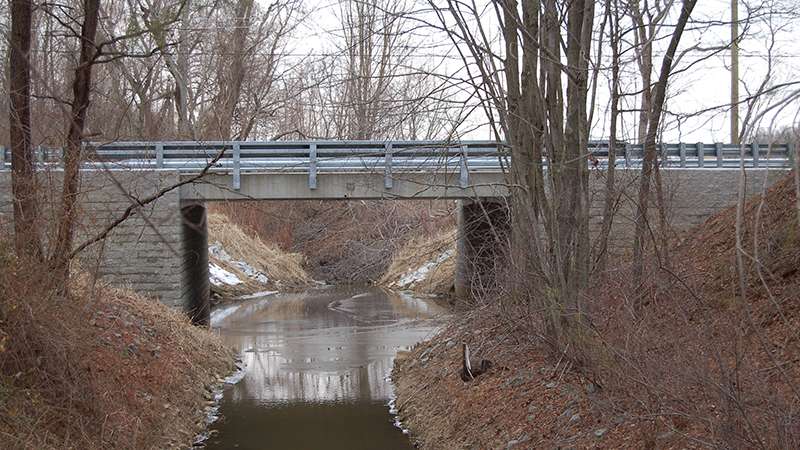 A new bridge replacement system allows for rapid and cost-effective construction. Image credit: Majid Talebi/University of DelawareWith America’s bridges receiving a grade of C+ in an American Society of Civil Engineers 2017 Infrastructure Report Card, the Delaware Department of Transportation decided to assess a novel replacement approach for an aged two-lane bridge.
Working in conjunction with researchers at the University of Delaware, the old bridge (located just north of the C&D Canal) was replaced with a geosynthetic reinforced soil integrated bridge system (GRS-IBS) developed by engineers at the Federal Highway Administration that is both rapid and cost-effective.
Researchers, inspired by retaining wall construction, used geosynthetic materials (textiles, strips, grids, nets) to provide tensile reinforcement to soils to enhance strength and stability.
According to Christopher Meehan, the Bentley Systems Incorporated Chair of Civil Engineering at UD, "It turns out that concepts from these technologies can also be applied to bridges, saving money and reducing construction time, The new bridge is basically a composite bridge structure that incorporates GRS abutments and prefabricated bridge superstructure elements. This approach eliminates the costly downtime associated with cast-in-place concrete, which can take a few weeks to a month to cure."
GRS abutments were created by laying local concrete masonry bricks in rows, filling certain sections with gravel and covering other sections with geosynthetic fabric.
Once paved, the bridge, outfitted with 150 sensors for the continuous monitoring of the bridge’s long-term performance, spans 37 feet.
"Geosynthetic reinforced soil structures are well-suited for construction all over the world, as geosynthetic materials are fairly light and can be easily imported," Meehan said.
"Beyond that point, various types of walls and bridge abutments can be constructed using locally sourced materials, with little need for cast-in-place concrete. The resulting structures are cost-effective and fairly forgiving with respect to settlement and lateral deflection, and they have been shown to perform relatively well in earthquakes."