
Autonomous, Reusable Experimental Spacecraft Being Developed by Boeing and DARPA
Peter Brown | May 24, 2017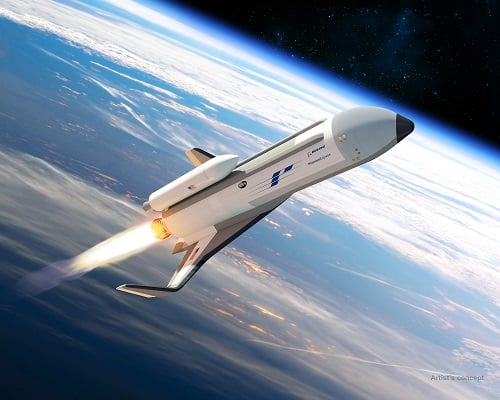 An artist’s rendering of the Phantom Express, a new aircraft capable of reaching space and launching satellites. (Source: Boeing)Boeing is collaborating with the U.S. Defense Advanced Research Projects Agency (DARPA) to design and test an experimental spaceplane capable of reaching deep space and returning to Earth.
Dubbed the Phantom Express, the spaceplane will be autonomous and reusable with the ability to carry and deploy a small expendable upper stage to launch small satellites into low Earth orbit. The spaceplane would be able to reach the edge of space then deploy the second stage and return to Earth.
After its mission is complete, the spaceplane would then land on a runway and be prepared for its next flight by using similar operation and maintenance principles found in modern aircraft.
“Phantom Express is designed to disrupt and transform the satellite launch process as we know it today, creating a new, on-demand space-launch capability that can be achieved more affordably and with less risk,” says Darryl Davis, president, Boeing Phantom Works.
Boeing says the Aerojet Rocketdyne AR-22 engine — a version of the Space Shuttle’s main engine — would power the spaceplane using liquid oxygen and liquid hydrogen fuel.
The Phantom Express will be designed with an advanced airframe as well as third-generation thermal protection to enable it to fly at high velocities. At the same time, it will feature a more affordable expendable upper stage for the satellite launching capability.
Boeing and DARPA plan to test the program in series of demonstrations consisting of 10 flights over 10 days.



Now we are talking progress. This is absolutely excellent!