Reducing the Environmental Impact of Delivery Trucks
S. Himmelstein | May 17, 2017Reducing the environmental and economic burdens of delivery trucks is the focus of ongoing research at Pennsylvania State University.
“The size of fleets has increased, the transportation networks have become more complex and, perhaps most importantly, there is an increased demand for timely deliveries in tighter timeframes,” explains Vittal Prabhu, a professor in the Harold and Inge Marcus Department of Industrial and Manufacturing Engineering. “Therefore, it is increasingly important to come up with innovative new ways to cut down the effect these vehicles have on the environment while keeping costs down and maintaining timely deliveries.”
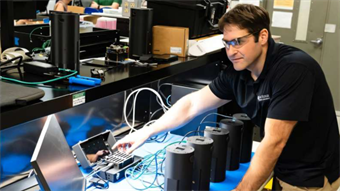
His research team developed a new algorithm – Greening via Energy and Emissions in Transportation  Professor Vittal Prabhu is developing new ways to reduce the environmental impacts of fleet vehicles, while keeping costs down and maintaining timely deliveries. Source: Min Xian(GEET) – to more effectively route fleet vehicles in order to reduce environmental effects. The approach is unique because the products in this system are delivered “just-in-time,” meaning exactly when a customer specified.
“GEET determines the optimal departure time and vehicle cruising speeds that can be varied throughout the trip based on anticipated vehicle performance and delivery times,” said Prabhu. “This is the feedback part of the ‘feedback control approach’ to the problem.”
Application of the algorithm results in, on average, a 12 to 16 percent reduction in fuel consumption, and implementation of this improvement within delivery systems occurs in a short amount of time.
In another study conducted with a researcher from Hongik University in Seoul, South Korea, the team looked at crowd-sourced parcel services, which functions like “Uber for deliveries.” In crowd-sourced parcel services, an individual can download an app to find packages that need to be delivered within their own neighborhood. This form of delivery is often faster than a single delivery truck, and with the growing popularity of on-demand transportation companies, such as Uber and Lyft, the cost for these personal deliveries is dropping.
App users see the payout for transporting a package and can decide to accept or decline the job. For this reason, this type of delivery system, with many unknown factors, is difficult to model. The supply and location of drivers, along with changes in demand for people to ship packages, is largely variable.
This uncertainty can cause the overall delivery system to have significant inefficiencies, such as, drivers needlessly driving long distances to pick up packages and dropping them off. With more driving, carbon is released and the system becomes less green.
The researchers then devised an algorithm that attempts to pair drivers and packages to certain routes in order to reduce the overall effect of unnecessary mileage and carbon emissions. When tested using computer simulations on a hypothetical crowd-sourced parcel company, this new method increased the company’s revenue by 6.4 percent by reducing fuel and emission costs by 2.5 percent.
The researchers plan to expand on their findings in order to offer more sustainable options to those within the delivery system sector.