New Flavin-based Electron Bifurcation Method Could Lead to Better Catalytic Processes
Peter Brown | May 09, 2017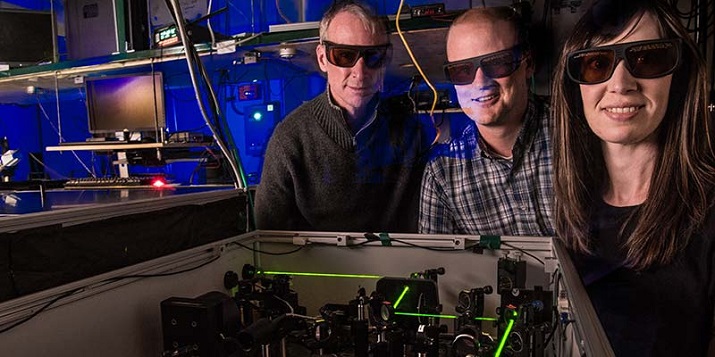 NREL researchers involved in the FBEB study, Paul King, David Mulder and Cara Lubner, stand next to a laser coupled with a spectrometer. Source: NRELThe U.S. Department of Energy’s National Renewable Energy Laboratory (NREL) has developed a new method to generate and conserve the energy required for cellular metabolism and survival.
Called Flavin-based electronic bifurcation (FBEB), the method is based on an ancient form of energy generation and conservation but is a new way in how scientists think about the way organisms obtain energy. FBEB works through previously unknown features of the catalytic mechanism that allows a unique Flavin molecule to be able to generate two levels of energy from a single precursor compound.
One level is used to perform an easy chemical reaction whereas another is much more energetic and can be used to perform more difficult chemistry to form a high-energy compound. The two reactions are coupled together so that energy that is normally wasted is conserved in the high-energy compound.
NREL researchers say FBEB allows more energy to be garnered from organisms by enabling the enzyme to perform energy conserving chemistry unlike anything previously studied. The research gives a new understanding of electron bifurcation and creates a model for the mechanistic principals by which they function.
“The results should enable new strategies for engineering biological systems for more efficient production of fuels and chemicals and for developing catalytic processes that optimize conversion of electrochemical reactions,” said Cara Lubner, NREL researcher. “Understanding the biochemistry of bifurcation will enable more informed strategies for bioengineering microbes to produce higher levels of biofuels and reduced chemicals.”
The method could be used to produce fewer by-products from catalytic processes enabling savings on materials and money spent on industrial processes. Researchers say it may also be possible to use this research to take advantage of energy-efficient pathways inside living cells by engineering microbes to better use them to make better products such as chemicals, fuels or hydrogen gas.
The details of the study can be found in the journal Nature Chemical Biology.