
A Solar Cell of a Different Stripe
S. Himmelstein | May 03, 2017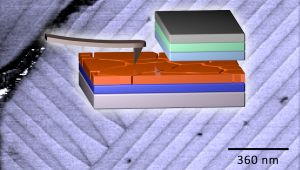 Stripes of nanostructures in perovskite solar cells. Image credit: Holger Röhm, Tobias Leonhard/KIT
Perovskite solar cells are highly efficient, converting more than 20 percent of incident light directly into usable power. Despite the promise of these devices, their light-absorbing layers must be made more robust to environmental impacts and the lead component must be replaced by environmentally compatible elements. Such improvement requires in-depth understanding of physical mechanisms that enable the high conversion rate of absorbed solar energy into electric power.
While investigating underlying physical mechanisms by means of piezoresponse force microscopy, a special type of scanning force microscopy, researchers at Karlsruhe Institute of Technology, Germany, (KIT) detected strips of nanostructures with alternating directions of polarization in the perovskite layers. These ferroelectric nanostructures might serve as transport paths for charge carriers.
During thin-layer development, lead iodide perovskites were observed to form about 100 nm wide strips of ferroelectric domains with alternating electric fields. This alternating electric polarization in the material might play an important role in the transport of photogenerated charges out of the solar cell and account for the special photovoltaic properties of perovskites. The researchers note that these structures seem to develop in perovskite solar cells by themselves under certain conditions.




This is not the first observation of spontaneously forming ordered structures by inanimate materials, although it is highly relevant to further improvements in all classes of PV materials.
The next question should focus on tuning the strips of polarization to to the point they might act as optical waveguides. One of the major losses of efficiency is re-radiation of secondary photons according to the equations that describe produced charge carrier density and lifetime.