
Low Proliferation Risk Fuel Tested for Research Reactors
S. Himmelstein | May 03, 2017Belgium, France, South Korea and the U.S agreed in 2012 to cooperate in the development of high-density low-enriched uranium (LEU) fuel production technology using centrifugal atomization technology developed by the Korea Atomic Energy Research Institute (KAERI). The project was launched to reduce the use of highly-enriched uranium (HEU), which poses a proliferation risk, as fuel in civil research reactors.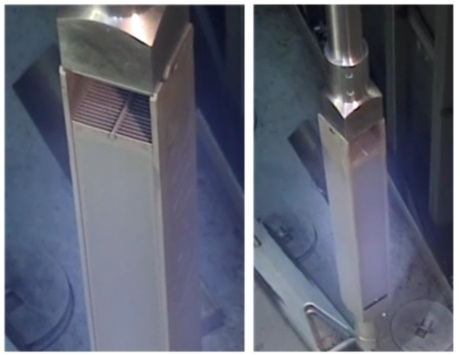 The U-Mo fuel assembly undergoing tests. Image credit: KAERI
The U.S. provided 110 kg of LEU in for KAERI to manufacture 100 kg of atomized uranium-molybdenum powder, which was subsequently shipped to France for fabrication into fuel elements by Areva's research reactor fuel manufacturer CERCA.
Testing of the experimental U-Mo fuel began in the Advanced Test Reactor at the Idaho National Laboratory in October 2015, and in April 2017 KAERI announced the successful completion of those verification tests.
The U-Mo fuel has a higher level of uranium density than uranium-silicon fuel, so it can use LEU instead of HEU. The fuel can also improve the performance of research reactors, according to KAERI.
Results from the fuel tests will be used to obtain a construction license for a new research reactor planned in Busan, South Korea, as the first application for the U-Mo fuel.



Kudos to the participants in this preparation of LEU (U-Mo) fuel cassettes, and to the testing facilities.
It is real progress, and also makes one wonder if re-processed fuel could be utilized, thus improving long-term burn up of the active isotope.