Water as an Energy Storage Medium?
S. Himmelstein | April 30, 2017A material incorporating atomically thin layers of water stores and delivers energy much more quickly than the same material that doesn’t include the water layers. The discovery by North Carolina State University researchers holds promise for shaping future energy-storage technologies.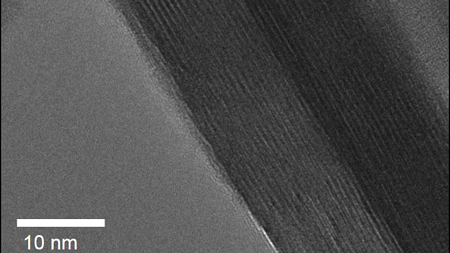 Low temperature high resolution transmission electron microscope image of a platelet of tungsten oxide dihydrate; the "stripes" are individual layers of atoms separated by water layers. Image credit: Veronica Augustyn and James LeBeau
Using water or other solvents to ‘tune’ the transport of ions in a layered material could allow an increased amount of energy to be stored per unit of volume, faster diffusion of ions through the material and faster charge transfer.
The researchers tested a crystalline tungsten oxide and a layered, crystalline tungsten oxide hydrate consisting of crystalline tungsten oxide layers separated by atomically thin layers of water.
The regular tungsten oxide stored more energy than the hydrate when the materials were charged for 10 minutes. But when the charging period was only 12 seconds, the hydrate stored more energy than the regular material. The hydrate also stored energy more efficiently—wasting less energy as heat.
These results demonstrate a new approach for developing pseudocapacitance in layered transition metal oxides for high-power energy storage, as well as the importance of energy efficiency as a metric of performance of pseudocapacitive materials.
The researchers are now moving forward with National Science Foundation-funded work on how to fine-tune this interlayer for the development of next-generation energy-storage devices. Possible benefits could include thinner batteries, faster storage for renewable-based power grids or faster acceleration in electric vehicles.