Mining Seawater for Nuclear Fuel?
Engineering360 News Desk | April 02, 2017Promoting nuclear power as a reliable source of carbon-free electricity is dependent on numerous safety, waste disposal, and fuel supply issues.
Researchers at Stanford University, CA, have devised an electrochemical technique to address the fuel supply problem.
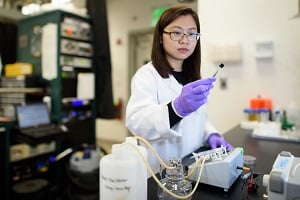 Stanford University researcher Chong Liu examines a carbon-amidoxime electrode used to improve extraction of uranium from seawater. Credit: L.A. CiceroThe researchers maintain that seawater may offer a secure supply of nuclear fuel for regions and nations lacking conventional uranium resources.
Previous research showed that uranium dissolved in seawater combines chemically with oxygen to form uranyl ions with a positive charge. Extracting these uranyl ions involved dipping plastic fibers containing amidoxime into seawater. When the strands become saturated, the plastic is chemically treated to free the uranyl, which then must be refined for use in reactors just like ore from a mine.
To improve on this process, the Stanford team developed hybrid conductive fibers composed of carbon and amidoxime. Pulses of electricity altered the properties of the hybrid fiber so that more uranyl ions could be collected.
In a capacity comparison test, by the time the standard amidoxime fiber had become saturated, Stanford’s amidoxime-carbon hybrid fibers had already adsorbed 9 times as much uranyl and were still not saturated. The electrified fiber captured three times as much uranyl during an 11-hour test using seawater from Half Moon Bay, about an hour from Stanford, and had three times the useful lifespan of the standard amidoxime.