
Discovered: the Most Structurally Complex Mineral on Earth
S. Himmelstein | March 08, 2018Exploration of an abandoned uranium mine in the Czech Republic has turned up ewingite, considered the most complex mineral on earth. It was discovered in the same region where uranium ore was mined for Marie Curie’s groundbreaking studies of radioactivity a century ago.
Researchers posit that ewingite had likely only grown over decades, after humans began interacting with the 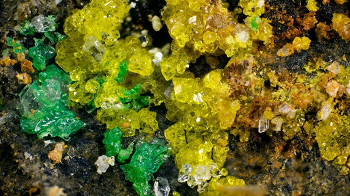 Source: Pavel Skachamine, and are analyzing data on uranium-based minerals to see if they can find variations between minerals that may or may not have been impacted by human existence. Additionally, the Burns lab is attempting to recreate the mineral to better understand the conditions that led to its formation.
The structure of ewingite, as determined by means of synchrotron X-ray diffraction, contains nanometer-scale anionic uranyl carbonate cages that contain 24 uranyl polyhedra, as well as calcium and magnesium cations and aqueous groups located in interstitial regions inside and between the cages.
The structural complexity of minerals can be measured by bits per unit cell and the average is about 228 bits. Ewingite is marked by 12,684.86 bits per unit cell.
The mineral was named in honor of Rodney C. Ewing, Frank Stanton Professor in Nuclear Security at Stanford University, for his contributions to the fields of mineralogy and nuclear science.
Researchers from the Academy of Sciences of the Czech Republic, Natural History Museum of Los Angeles, University of Chicago and University of Notre Dame participated in this discovery.

Amazing story. To think my humble name may be attached to the most complex mineral. My family is flattered. Tom Ewing, sousafan2@yahoo.com.