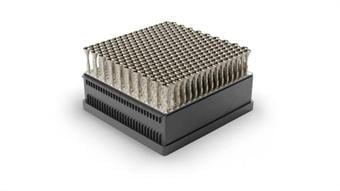
Durable Materials for Night-Vision Cameras
Engineering360 News Desk | March 01, 2017Night-vision cameras that are essential to the security sector are prone to failure due to degradation under temperature stress.
 Northwestern University engineers in Illinois have improved on the design of a key component used for making high-performance, long-wavelength infrared photodetectors for these cameras and other applications. Commonly used mercury-cadmium-telluride has been replaced with indium arsenide/indium arsenide antimonide type-II superlattices.
The heat-sensitive ionic bonds in mercury-cadmium-telluride degrade under thermal stress while the replacement is safer and more durable than mercury. A sawtooth superlattice design was used to implement the electron barrier of the photodetectors.
A photodetector equipped with the superlattice electron barrier limits the obstructing dark current density and raises the background limited infrared photodetection temperature. Infrared cameras can then perform imaging at higher operating temperatures with reduced requirement for cryogenic cooling power inside the camera.