
Old Technology Yields Advanced Functional Material
Engineering360 News Desk | January 19, 2017Researchers have woven a material that mimics periosteum, a tissue that envelops most bones in the human body, paving the way for designing smart materials based on the tissue’s composition.
This advance can make a substantive practical impact on products from protective suits for astronauts to radial tires.
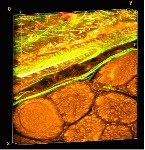 Photomicrograph of periosteum (upper diagonol). Credit: Prof. Melissa Knothe Tate, UNSWBiomedical engineers led by Professor Melissa Knoth Tate of the University of New South Wales mapped the arrangement of collagen, elastin, and other structural proteins in periosteum. They say the tissue exhibits remarkable resilience and provides bones with extra strength under heavy loads, desirable characteristics to weave into manmade advanced materials.
The research involved mapping periosteum and using the information gleaned from its structure to inform a method of weaving a similar material. The team used a high fidelity imaging system to investigate the tissue’s architecture and then translated the structure into a computer model. Using this model, computer-aided design software created a recipe for weaving fabric.
The second research phase relied on a piece of old technology, a jacquard loom. Jacquard looms, first demonstrated in 1801, are one of the first examples of an analog computer. Instead of collagen and elastin, which are too small for the loom, the team substituted elastic materials and programmed the loom with a twill weave pattern. Mechanical testing of the initial swatches found that the new fabric exhibited similar properties to periosteum.
The research team’s primary focus is on biomedical applications for their technique. Weaving replacements for body tissues is one potential application. Periosteum and other human tissues could find industrial applications. One tire manufacturer suggested a titanium weave for belted tires.

The Jacquard loom would be an example of an early digital computer. Just because it is old and not electronic doesn't make it analog. Punch cards are discrete - hole is either punched or not punched.