Manufacturing Medical Microdevices with iMEMS
Engineering360 News Desk | January 17, 2017A process for manufacturing biocompatible implantable microdevices with applications that include targeted drug delivery and cardiac pacemakers has been developed by Columbia University biomedical engineers.
The fast manufacturing technique exploits the unique mechanical properties of hydrogels to yield a “locking mechanism” for precise actuation and movement of freely moving parts, which can provide functions such as valves, manifolds, rotors, pumps, and delivery of payloads (see video).
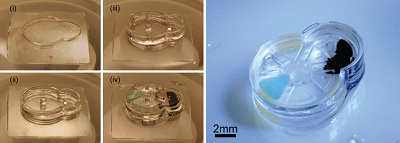 Left: Layer-by-layer fabrication of support structures and assembly of gear components. Right: The complete device after layers have been sealed. Credit: Sau Yin Chin/Columbia EngineeringUnlike the static components of current implantable microdevices, these biomaterials can be tuned within a wide range of mechanical and diffusive properties and can control them after implantation without a sustained power supply such as a toxic battery.
To build the “implantable microelectromechanical systems” (iMEMS), the researchers used light to polymerize sheets of gel and incorporated a stepper mechanization to control the z-axis and pattern the sheets layer by layer, giving them three-dimensionality. Controlling the z-axis enabled the researchers to create composite structures within one layer of the hydrogel while managing the thickness of each layer throughout the fabrication process.
In a mouse model of bone cancer, triggering of release of doxorubicin from the device over 10 days showed high treatment efficacy and low toxicity, at 1/10 of the standard systemic chemotherapy dose.
The iMEMS technique addresses several fundamental considerations in building biocompatible microdevices, micromachines, and microrobots: how to power small robotic devices without using toxic batteries, how to make small biocompatible moveable components that are not silicon which has limited biocompatibility, and how to communicate wirelessly once implanted.