
Coming in 2018: The New Kilogram
Abe Michelen | January 12, 2017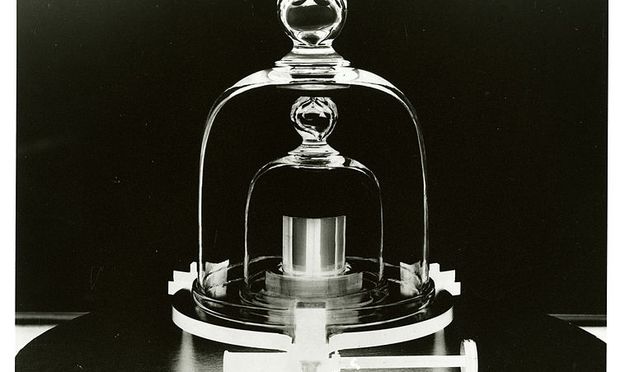 The IPK cylinder kept in France, used to define the kilogram. Courtesy of BIMPThe kilogram, the basic metric unit of mass, is about to change. The kilogram is the only basic SI unit based on a physical object. For over 125 years the kilogram has been defined as the exact mass of a small platinum and iridium cylinder kept in a triple-locked vault which is kept by the International Bureau of Weights and Measures (BIPM) in Sevres, France.
This cylinder is the International Prototype of the kilogram (IPK) is used to calibrate every mass unit or weight worldwide. The IPK, or Le Grand K in French, is kept in a well-protected vault that is visited every year by three French officials, each one with a separate key. They enter the vault just to observe that the cylinder is still in the same place as it was found the year before; then they leave the cylinder to sit until the next year’s visit. This procedure has been going on for the last 125 years.
It is, of course, impossible to calibrate all our mass and weight measurements to the IKP, given the fact that the only original is in Paris. For this reason the national metrology institutes of several nations keep one of more copies of the IPK to be used to calibrate mass measurements in those countries. These are called ‘working standards’ that are normally used to calibrate further standards. This is the way the kilogram is disseminated across the world and nations.
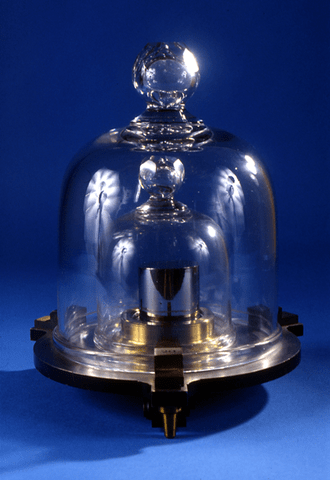 Prototype of K20 at the NIST. Courtesy of the NISTIn the United States, the keeper of the unit of mass—in fact, of all seven SI units—is the National Institute of Standards and Technology (NIST) located in Gaithersburg, Md. The primary working standard of the kilogram is called K20 and is the first of two prototypes assigned to the United Stated in 1889. The NIST maintains six more platinum-iridium prototypes (K79, K85, K92, K102, K104 and K105) used for comparison tests.
The scientific community knew for many years now that this system was not reliable, mainly because the measured mass of each individual standard drifts over time. In 1998, for instance, the IPK was measured by the BIPM metrologies and, to their disappointment, it was found that the cylinder has drifted by 70 micrograms since 1889. Even if this change is small—less than the mass of a sugar grain—it is a troubling trend.
“It’s a bit ridiculous in this day and age, because it’s not just the mass that depends on the prototype. It’s all energy, all force, all units that are linked in any way to the kilogram,” said Terry Quinn, former director of the BIMP, in an interview with IEEE Spectrum. For this reason Quinn has been campaigning since 1990 to define the kilogram using an unchanged constant of nature.
“Such a change would be a boon to scientists who depend on stable units to perform long-term measurements,” Quinn said. “It could also have a big impact on electrical engineering, particularly for makers of precision multimeters and other basic tools.
To understand the importance and urgency to re-define the kilogram, just look at the following table:
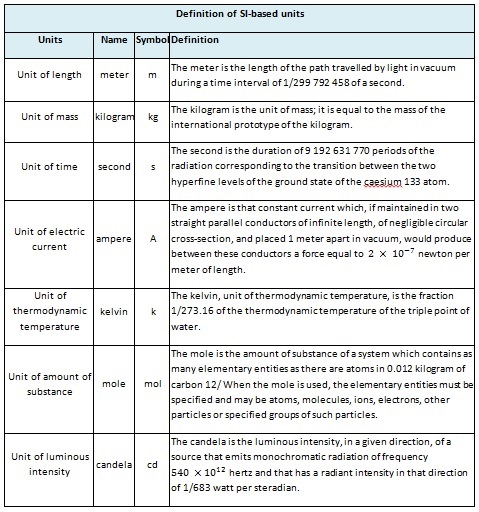
In the table are the seven basic SI units, all of which—with the exception of the kilogram—are based on universal constants. Note that with an improved kilogram, the mole unit will also benefit.
Luckily, the international community decided to address the problem. In 2018 the kilogram will be redefined in terms of a constant of nature: the Plank constant. However, the scientific community will still need to translate the new definition into a physical object, so the standard can be distributed across the world.
There are two contenders to achieve this realization process: watt balance and silicon spheres. Both of these methods require delicate consideration. This will be covered in a future article.



A typo in the table above: the unit for temperature is shown as kg (kilogram) when in fact the actual unit is kelvins, or K.
-AW
I fixed it for you