Chip May Help Detect Cystic Fibrosis Bacteria
Engineering360 News Desk | January 12, 2017Researchers at DTU Nanotech in Denmark are developing a chip that is able to detect specific gases produced by bacteria in the lungs. When a patient breathes onto the chip, gases are detected and airway infections can be diagnosed.
Chronic lung infections caused by the bacterium Pseudomonas aeruginosa are responsible for the majority of illnesses and deaths among cystic fibrosis (CF) patients. Therefore, it is important to detect the infection and give antibiotics before the infection becomes chronic.
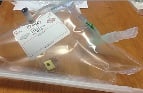 The device contains the SERS substrate and is exposed to breath from a patient.Children below the age of 8-9 years do not produce sufficient amounts of sputum in the airways to cough up a sample. Therefore, a tube is inserted through the nose and into the larynx to induce a cough reflex, and a sample for microbiological investigation is obtained through the tube.
Especially for young children, this can be an unpleasant experience. In Denmark, CF patients are tested for the presence of P. aeruginosa on a monthly basis. A quick, sensitive and non-invasive test for P. aeruginosa would facilitate more frequent sampling and thereby an earlier diagnosis of airway infections.
According to the researchers, the hope is that the chip can be developed into a point-of-care device for home diagnostics of P. aeruginosa lung infections. This would mean less suffering and a possible longer life expectancy for the patients.
P. aeruginosa emits the poisonous gas hydrogen cyanide (HCN), which is specific to this bacterium and can be used as a biomarker. This means that patients with early P. aeruginosa infections have HCN in their breath. HCN can be detected on the chip down to part-per-billion levels, which corresponds to the level found in the breath of a child with an early P. aeruginosa infection.
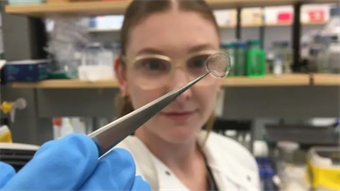
Researchers explain that the chip is equipped with nanopillars and thanks to these, breath detection based on the so-called surface-enhanced Raman scattering (SERS) is possible. The technology is described in the article Nanopillars—A State-of-the-Art Optical Sensor.
The original nanopillar chip was developed by Senior Researcher Michael Stenbæk Schmidt to detect explosives in the air. However, modifications make the chip useful for other applications. In Rikke Kragh Lauridsen’s PhD project the chip has been optimized to detect cyanide in the gas phase. This was done by changing the metal layer on top of the nanopillars from silver to gold; by including extra cleaning steps in the preparation of the chip and by changing the metal layer thickness and the rate for deposition of the metal.
Researchers started to work with HCN in the gas phase and after this had been demonstrated, they made serial dilutions of potassium cyanide (KCN). The serial dilution experiments were made to establish the limit of detection for cyanide on the chip.
Microbiological investigations were then made, detecting HCN above cultures of P. aeruginosa isolated from the airways of children with CF. In the spring of 2016 the chip was taken to the first clinical pilot study at Rigshospitalet in Copenhagen, which included 50 CF children and 19 control patients. Researchers say the results are encouraging.