Test for Reactor Vessel Damage Assessment
Engineering360 News Desk | January 05, 2017An analytical method pioneered by MIT researchers could change the way operators measure damage to nuclear reactor vessels. This method could potentially provide continuous monitoring and prevent unnecessary replacement of materials.
Nuclear reactor vessels and other materials that are exposed to long-term radiation incur degradation over time. The current standard method for assessing damage, transmission electron microscopy (TEM), detects many, but not all, material defects.
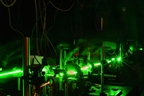 A system to monitor radiation damage in a material creates acoustic oscillations by using two pulsed laser beams.“We’re not just interested in how many voids or vacancies you have,” says Michael Short from the research team, referring to places where one or more atoms are missing from the material’s crystal lattice. “What we really want to know is how the material properties are changing.”
Short and his team developed a testing method that uses acoustic vibrations to gauge material damage levels. This method, transient grating spectroscopy, induces and monitors acoustic waves on the material’s surface. Although the system only “sees” the outer surface of the tested material, unseen defects affect the acoustic vibrations.
To create the acoustic waves, the researchers aimed two pulsed laser beams at a sample so that the light waves created an interference pattern. The interference warmed the sample’s surface, in turn creating a standing acoustic wave. A second set of lasers measures how fast the waves move and how quickly they decay.
This technique generated some skepticism about the test’s sensitivity. The researchers devised an experiment using perfect single aluminum crystals with different surface orientations. The samples were visually identical; transient grating spectroscopy correctly identified each variation.
Short says that this technique detected changes in wave speed as small as one-tenth of one percent. The test provides results in seconds rather than months or years for other testing methods.
To continue to fine-tune the transient grating spectroscopy method, the team is using computer simulation of different structures to predict responses of copper and aluminum samples. Actual test results have confirmed the predictions.
This testing method will help materials scientists develop new nuclear reactor cladding, thereby removing one roadblock to deploying new reactors.