Papertronics Battery on a Single Sheet of Paper
Engineering360 News Desk | December 22, 2016Researchers at Binghamton University, State University of New York have created a bacteria-powered battery on a sheet of paper that can power disposable electronics.
The manufacturing technique may reduce fabrication time and cost, and the design could revolutionize the use of bio-batteries as a power source in remote, dangerous, and resource-limited areas.
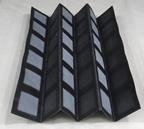 The bacteria-powered battery can power disposable electronics. Credit: SeokheunAccording to researchers, papertronics have recently emerged as a simple and low-cost way to power disposable point-of-care diagnostic sensors. Stand-alone and self-sustained, paper-based, point-of-care devices may become essential to providing effective and life-saving treatments in resource-limited settings.
On one half of a piece of chromatography paper, researchers placed a ribbon of silver nitrate underneath a thin layer of wax to create a cathode. They then made a reservoir out of a conductive polymer on the other half of the paper, which acted as the anode. Once properly folded and after a few drops of bacteria-filled liquid were added, the microbes' cellular respiration powered the battery.
Different folding and stacking methods can improve power and current outputs. Scientists were able to generate 31.51 microwatts at 125.53 microamps with six batteries in three parallel series, and 44.85 microwatts at 105.89 microamps in a 6 x 6 configuration.
It would take millions of paper batteries to power a common 40-watt light bulb. But on a battlefield or in a disaster situation, usability and portability are paramount. Plus, there is enough power to run biosensors that monitor glucose levels in diabetes patients, detect pathogens in a body or perform other life-saving functions.
The study—led by Assistant Professor Seokheun "Sean" Choi, who is in the Electrical and Computer Engineering Department within the Thomas J. Watson School of Engineering and Applied Science and is also the director of the Bioelectronics and Microsystems Lab at Binghamton—is the latest step in paper battery development by Choi. His team developed its first paper prototype in 2015, which was a foldable battery that looked much like a matchbook. Earlier in 2016 they unveiled a design that was inspired by a ninja throwing star.