Origami Ninja Star Inspires Battery Design
John Simpson | June 16, 2016A new disposable battery that folds like an origami ninja star could power biosensors and other small devices for use in challenging field conditions.
The device, developed by Binghamton University Assistant Professor of Electrical and Computer Engineering Seokheun Choi and two of his students, is a microbial fuel cell that runs on the bacteria available in a few drops of dirty water.
Choi previously developed a paper-based origami battery. That design, shaped like a matchbook, stacked four modules together. The ninja star version, which measures about 2.5 inches wide, boasts increased power and voltage, with eight small batteries connected in series.
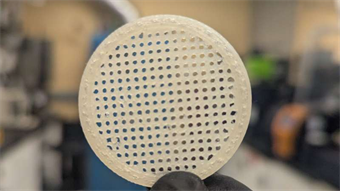
 The battery measures about 2.5 inches wide, with eight small batteries connected in series. Image credit: Binghamton University.“Last time, it was a proof of concept. The power density was in the nanowatt range,” says Choi. “This time, we increased it to the microwatt range. We can light an LED for about 20 minutes or power other types of biosensors.”
Existing paper-based biosensors include pregnancy tests and HIV tests. However, the sensitivity of such tests is limited, Choi says, and a battery like his could allow the use of more sophisticated fluorescent or electrochemical biosensors in developing countries.
“Commercially available batteries are too wasteful and expensive for the field,” Choi says. “Ultimately, I’d like to develop instant, disposable, accessible bio-batteries for use in resource-limited regions.”
The new design folds into a star with one inlet at its center and the electrical contacts at the points of each side. After a few drops of dirty water are placed into the inlet, the device can be opened into a Frisbee-like ring to allow each of the eight fuel cells to work. Each module is a sandwich of five functional layers with its own anode, proton exchange membrane and air cathode.
Choi’s original matchbook-sized battery could be produced for about 5 cents. The new ninja star device is more expensive—roughly 70 cents—in part because it uses not only filter paper, but also carbon cloth for the anode and copper tape.
The team’s next goal is to produce a fully paper-based device that has the power density of the new design and a lower price tag.