
PV Systems' Degradation Rates to Be Measured, Publicized
John Simpson | December 12, 2016The newest photovoltaic (PV) modules to be installed outside the Department of Energy's National Renewable Energy Laboratory (NREL) Colorado headquarters will measure how their efficiency at converting sunlight into electricity changes over time. That change, called the degradation rate, will be posted on NREL's website along with the manufacturers' names.
NREL researchers have examined the results of nearly 200 studies and found this degradation rate ranges from 0.5%-1% a year, depending on the technology used. A high degradation rate means that less power will be produced over the lifetime of a PV system, which increases the per-kilowatt-hour cost of generating solar electricity.
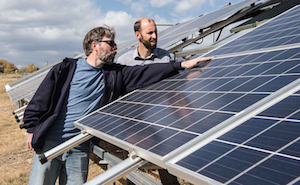 NREL engineers Bill Sekulic (l) and Chris Deline examine a new PV array outside NREL's headquarters building in Colorado. Image credit: Dennis Schroeder.To start the project, 50 solar modules made by three manufacturers will be deployed in 2017. Then, each year for the following two years, additional sets of 50 modules made by other companies will be added.
"We're going to buy up modules that represent the average cross-section of installed modules each year in the United States and see how they do over time," says Chris Deline, an engineer at NREL who also serves as director for Colorado's two regional test centers: SolarTAC (an eight-acre site near Denver International Airport) and one located on NREL's campus in Golden. The test centers are used to validate new technologies and measure the performance of solar modules over time.
Once completed, the new solar array field will house four rows of PV modules. The first row, already in place, is for partner manufacturers' modules that NREL is either studying or comparing against similar products. For example, SolarCity has NREL testing its modules against those made by a Chinese manufacturer.
Further along the row, high voltage (up to 1,500 V to represent the high voltages used in some PV systems today) is applied to modules of a range of constructions. This helps quantify their susceptibility to degradation associated with the leakage currents that can occur at these high system voltages. How the modules do at NREL will be assessed against the performance of identical setups in Singapore and China.
"This greatly expands our ability to work with commercial partners," Deline says. "The other neat thing is it allows us to get access to some of these cutting-edge products, because a lot of this stuff is not commercially available."
Although the degradation rates for modules will be made public, the contracted testing done for clients will be kept confidential.



There is already a lot of data out there on degradation rates. The question is, ''What is actually degrading in the PV and is there any synergism in the over-all degradation rate due to combinations of component degradation?''
Stuff wears out. In the mid to late 1990's bigger, better, etc. was all the rage in the wind power media. Now, the media has morphed into the No. 1 topic being, ''How do we keep all the moving parts of this stuff working properly?'' In PV the media hype still includes efficiency, but is increasingly focused in getting the BOS costs down and keeping the non-moving parts from crapping out for whatever reason. All life time costs are coming down, but the spread between roof top PV and PV farms seems to be growing, with the lowest tariffs for PV farms on the Arabian peninsula coming in under $0.03 per kwhr.