New Insight into Why Materials Break
John Simpson | November 30, 2016New research suggests that scientists could eventually help design materials that resist breaking—or at least crack in a predictable fashion.
Using both a simulation and artificial structures called metamaterials, scientists at the University of Chicago, New York University and Leiden University, in the Netherlands, found that a material's failure can be continuously tuned through changes in its underlying rigidity. The research was the result of experiments and computer simulations in which researchers examined the effects of varying the rigidity of a material.
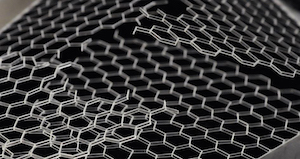 A plastic honeycomb lattice was pulled apart in an experiment studying how material rigidity affects the way things break. Image credit: Sidney Nagel, et al.“This research suggests that there is a new axis that can be explored and possibly exploited in determining how materials fail,” says Sidney Nagel, professor of physics at the University of Chicago.
As a solid approaches a certain level of rigidity, its failure behavior changes dramatically, and the nature of the break is profoundly different at high and low rigidities, the research concluded. Studying and controlling this in a systematic way will give scientists a better understanding of how materials break.
When a system is rigid, such as window glass, its bonds are tightly packed and break in clean, narrow and relatively straight cracks. When a system is floppy with low rigidity, however, it has fewer bonds, and those bonds first tear at seemingly random places throughout the material. Eventually there are so many broken bonds that the tears connect in an irregular pattern and cause the material to break.
Researchers also found that as a material is made more flexible, its failure zone becomes wider, providing scientists a better view of what is happening. Instead of studying materials at a microscopic scale, researchers can make them less rigid, in essence blowing up the cracking region.
“Reducing the rigidity of a material is, in a sense, like holding a magnifying glass that allows you to zoom in on the width of a crack, which is generally microscopic but can become as big as the sample size,” says Vincenzo Vitelli, physicist at the Lorentz Institute at Leiden University.
Scientists familiar with the research say the research provides a broader understanding of why materials fracture and opens up new areas of study, including how cracking and failure can be controlled.
“A systematic theory, hinted at here, could allow us to predict the damage around a crack, the stresses, the meandering and, most important, how all of these factors might vary as one changes how we make the material,” says James Sethna, professor of physics at Cornell University, who did not participate in the research. “Trial and error could be replaced by a beautiful, systematic approach.”