Road-Ready Fuel from Carbon Dioxide?
Engineering360 News Desk | November 22, 2016A pathway for the direct conversion of carbon dioxide to road-ready liquid transportation fuels by reaction with renewable hydrogen produced by solar water splitting is reported by South Korean researchers.
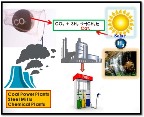 Proposed carbon capture and utilization scheme based on catalytic conversion to hydrocarbon fuels with hydrogen supplied by solar water splitting.The carbon capture and utilization system developed at Ulsan National Institute of Science and Technology (UNIST) is enabled by use of a delafossite-based catalyst that converts CO2 into hydrocarbon-based fuels, such as diesel fuel, in a single step.
The earth-abundant copper and steel catalyst is applied in a reaction between CO2 captured from industrial plants and H2 generated from solar hydrogen plant to produce diesel.
Heavy hydrocarbons are produced from CO2 hydrogenation in the same manner as from conventional CO-Fisher-Tropsch (FT) synthesis. However, this direct CO2-FT synthesis differs from German car maker Audi’s recently developed CO2-to-dielsel conversion process, which actually involves two steps – reverse water gas shift reaction to CO followed by CO Fisher-Tropsch (FT) synthesis.