"BioSwimmer" Tested for Port Inspections
John Simpson | November 11, 2016Robots are bringing an important layer of security to U.S. ports—disguised as fish.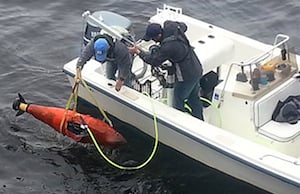 BioSwimmer is a biomimetic system modeled after the bluefin tuna, known for its extraordinary swimming agility. Image credit: Boston Engineering.
Developed by Boston Engineering and funded by the Department of Homeland Security Science and Technology Directorate (S&T), BioSwimmer is a semi-autonomous underwater vehicle equipped to inspect a vessel’s exterior for illicit cargo and contraband, as well as harbor facilities for unwanted activity. It is a biomimetic system modeled after the bluefin tuna, known for its extraordinary swimming agility. Similar to the bluefin, BioSwimmer has the ability to twist and turn in limited space within the water, which sets it apart from most other remotely operated vehicles.The vehicle and its onboard sensors work to inspect the outside of ships for drugs and other contraband that are attempting to be smuggled across the border underwater. This inspection is enabled through BioSwimmer’s ability to maneuver within the confines of ships’ propulsion, steering and recesses—all while maneuvering in the water like an actual fish.
Demonstrations of the developmental BioSwimmer have been ongoing since late 2013—most recently in July 2016 at the Port of Charleston for the U.S. Customs and Border Protection's (CBP's) Atlanta-area port director's conference. At that demonstration, it conducted a search of six ships, one barge and one bridge abutment and hunted for a lost shipping container in the harbor channel.
“This next-generation unmanned underwater vehicle could be leveraged widely by the United States Coast Guard and CBP to inspect ships and piers for contraband and other material,” says S&T Program Manager David Taylor.