Service Robots Replace Human Workers at an Increasing Rate
John Simpson | November 01, 2016As technology improves and prices fall, professional service robots are increasingly doing jobs formerly handled by human workers. Revenue from professional service robots reached $2.6 billion, with approximately 20,000 units shipped in 2015, according to a new report from IHS Markit.
IHS Markit forecasts that the market for professional service robots will grow very quickly, with a unit-shipment compound annual growth rate (CAGR) of 46% from 2015 to 2020. After 2020, the global market for professional service robot markets will grow even faster, with more robots moving from prototype to commercialization in various applications, according to the report.
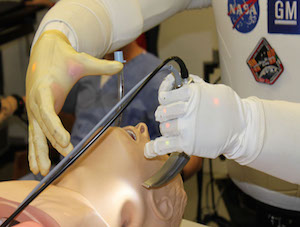 Robotic technologies are increasingly being used in the healthcare industry. Image credit: NASA. “The agriculture industry, logistics, medical and care and domestic help are the early-adoption industries for professional service robots,” says Wilmer Zhou, senior analyst, manufacturing technology.
Automated agricultural machinery is gradually replacing the work formerly handled by farmers, the report says. Demand for service robots has grown particularly for agricultural jobs such as seeding, planting, harvesting, pruning, weeding, picking, sorting, spraying and materials handling.
In the logistics sector, service robots are increasingly being deployed in automatic warehouses. Exemplified by Amazon’s recent acquisition of Kiva Robotics, large companies have actively invested in logistics and automated warehouse applications to reduce the number of workers and increase efficiency, according to the report.
The medical, health and domestic care industries are also making significant progress in service robot deployment. With surgical robot prices falling, and their use in medical operation tasks growing, the medical industry will continue to be one of the fastest growth sectors for robots, IHS Markit forecasts. Demand for domestic-help robots is being driven by the aging of the global population—particularly in Japan, Germany and other developed countries.