A Step Toward Water-skimming Robots?
John Simpson | October 31, 2016Water striders’ ability to walk and jump on the surfaces of ponds and lakes has inspired robot designers who want to mimic the bugs’ talent.
Now, engineers from Tsinghua University in China have measured parameters that allow them to walk on water—by studying their leg shadows. Their findings could contribute to designs for water-skimming robots.
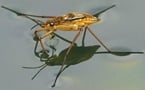 Water striders expel water by use of their hairy legs. More than 2,000 years ago, Greek scientist Archimedes explained flotation, stating that the upward, floating force on an object in water equals the weight, or downward force, of the water displaced. The principle has informed the building of ships, submarines, and other aquatic vehicles.
But for tiny water striders, water isn’t displaced. It is expelled by the insects' hairy legs. The updated Archimedes principle predicts that the weight of the expelled water should equal the floating force. But confirming this prediction experimentally is a challenge.
Because water striders are so light, they are almost impossible to weigh using conventional techniques. So researchers used an unconventional method: analyzing the shadows cast by the insects’ legs.
They placed a white sheet of paper at the bottom of a lab aquarium housing water striders and installed a light source above the water. According to the researchers, the insects’ stick-straight legs cast shadows that were rounded, representing the curvature of the water and the expelled water volume from which the floating force and weight can be calculated. From these measurements, the striders’ shifts in weight and body angle could be detected.
A video explaining more about the study can be viewed here.