PhyloChip Helps Pinpoint Water Contamination
John Simpson | October 19, 2016Scientists from the Lawrence Berkeley National Laboratory (Berkeley Lab) have developed a DNA-based method to detect and distinguish sources of microbial contamination in water. Using the PhyloChip—a credit card-sized device that can detect the presence of more than 60,000 species of bacteria and archaea—was found to be more sensitive than conventional methods in assessing health risks.
In tests at the Russian River watershed in northern California, the Berkeley Lab researchers found instances in which their method identified potential human health risks that conventional fecal indicator tests had failed to detect. Conversely, they also found instances where the conventional tests flagged bacteria that weren’t likely risks to human health.
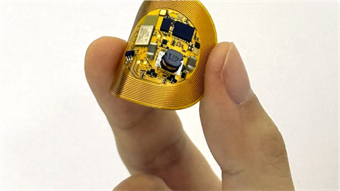
 PhyloChip can detect the presence of more than 60,000 species of bacteria and archaea. Image credit: Eric Dubinsky and Laleh Coté.“With the PhyloChip, in an overnight test we can get a full picture of the microorganisms in any given sample,” says microbial ecologist Eric Dubinsky. “Instead of targeting one organism, we’re essentially getting a fingerprint of the microbial community of potential sources in that sample. So it gives us a more comprehensive picture of what’s going on. It’s a novel way of going about source tracking.”
Local water agencies collect water samples, culture the bacteria overnight and then check the growth level of two types of bacteria, E. coli and Enterococcus, which are presumed to be indicators of fecal contamination. However, this method doesn’t distinguish among sources; the bacteria might have come from humans, cows, ducks or decaying vegetation.
PhyloChip, which was developed by microbial ecologist Gary Andersen and several other Berkeley Lab scientists, has been used for a number of medical, agricultural and environmental purposes, including understanding air pollution, the ecology of coral reefs and environmental conditions of the Gulf of Mexico after the Deepwater Horizon oil spill. With 1 million probes, it identifies microbes based on variations of a specific gene, with no culturing needed.
Determining the source of any particular pathogen is not a straightforward task. In most cases, a single microbe is not a definitive marker of an animal or other source. A cow, for example, may have 1,000 different organisms.
So Andersen and Dubinsky had an idea: collect feces from all sorts of animals and develop a reference library of the microbial communities that occur in different animals. The new method takes the unknown sample and compares it against this microbial reference library.
If the source is an animal that is not in the reference library, PhyloChip can still point the researcher in the right direction. In one study, for example, the sample was a chicken. “We hadn’t analyzed chickens, but we had geese, gulls and pigeons. We were still able to determine that the sample was a bird," Dubinsky says.
The team is now working on characterizing the microbial community of naturally occurring E. coli and Enterococci, using Hawaii with its warm waters as a testing ground. “They can occur naturally in sediments and decaying kelp and vegetation,” Dubinsky says. “It is known that they do, but nobody has developed a test to definitively show that.”
They are also working with the U.S. Environmental Protection Agency, which is looking at new technologies for what it calls “next-generation compliance.” Ultimately, the goal is to develop their method—possibly with a downsized version of the PhyloChip—to the point that it can be universally used in any location by non-experts.