Building the Next Generation of Hard Drives
John Simpson | October 10, 2016As the density of data stored on hard drives approaches multiple terabytes per square centimeter, the precision of their internal components becomes increasingly significant. Researchers from Singapore's Agency for Science, Technology and Research (A*STAR) have designed a system that they say achieves new levels of micro-positioning.
Hard disk drives consist of thin magnetic platters with data bits arranged on concentric tracks. The data bits are written and read by a magnetic recording head that floats a few nanometers above the platter surface at the end of a "slider" arm while the platter spins at high speed beneath it.
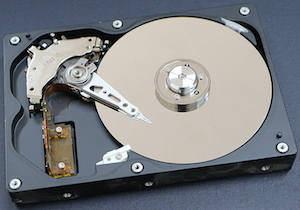 Hard drive data is written and read by a magnetic recording head that floats nanometers above a platter at the end of a "slider" arm while the platter spins beneath it. Image credit: Pixabay.Modern disk drives contain up to a million tracks per inch and track widths as narrow as 25 nanometers—and that density increases every year. Future disk drives will require extraordinarily precise head positioning and responsiveness to meet increasing performance expectations.
“The actuator mechanism will need to be able to position the recording head with a precision of just one or two nanometers,” explains Jiaping Yang, an engineer at the A*STAR Data Storage Institute. “The actuator schemes commonly used today can offer a fast response but will have difficulty achieving the positioning accuracy needed for future high-density drives.”
Yang and colleagues from A*STAR and Singapore's Nanyang Technological University have investigated the possibility of using an electrically activated thermal expansion element to control the position of the recording head at the end of the slider. The latter provides the larger-scale movement needed to navigate across multiple tracks. Their electro-thermal element is called a thermal unimorph and consists of a comb-like set of silicon teeth interlaced with polymer expanders.
“Silicon has high thermal conductivity but small thermal expansion, while the polymer expander has a large thermal expansion coefficient but low thermal conductivity," Yang says. "When we resistively heat the element by applying electricity to the silicon, the polymer expands, causing the silicon comb to bend.”
Although the thermal unimorph can be controlled with nanometer precision, its range of motion was previously too limited to be of practical use. Yang and his team overcame this limitation by adding a rotary lever action that magnifies the stroke length by six times.
“We are now exploring possible approaches to improve actuation speed performance, such as designing a more efficient heat path, investigating new thermally active materials and further miniaturization of the actuator footprint,” Yang says.