"Circular Building" Aims to Maximize Reuse of Materials
John Simpson | September 29, 2016A building designed and constructed out of reusable components was showcased as part of the London Design Festival to demonstrate how "circular economy" thinking can be applied to the built environment.
Developed by Arup, Frener & Reifer, BAM Construction and the Built Environment Trust, the Circular Building explores how the industry can work toward zero waste. Typically, the construction industry operates within a linear economy of "make, use and dispose."
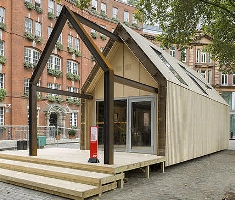 The prototype explores how the building industry can work toward zero waste. Image credit: Ben Blossom.The prototype is designed and constructed with materials that can be removed with minimum damage, helping each component to retain its value. Digital technology is used to "tag" all items, from window frames to individual fixings, each with a unique quick-response code containing information allowing it to be reused.
Data collected from the build can be viewed in a virtual materials database. A high percentage of materials and products were sourced with a cradle-to-cradle design ethos:
· Steelwork is made from off-cuts leftover from other projects.
· Timber floor joists will be reused via BAM’s in-house database for reused timber.
· A certified crade-to-cradle timber rainscreen clads the outside.
· Walls consist of open-source CNC-machined Wikipanels, using boards made from agricultural waste, bonded with natural resin and assembled with screws and push-fit connections.
· Rooflights can be removed in one piece and will be resold as new units.
· Glazing uses uncoated glass, which improves its recyclability, and both the waterproofing layer and the curtainwall system use no adhesives or site-applied sealants, facilitating deconstruction.
“By participating in this experiment, our aim has been to test if this approach could be widely adopted," says Stuart Smith, director, Arup. "The Circular Building shows that through collaboration and digital technology, we can design buildings where the materials can be reused.”