Extending Battery Life for Mobile Devices
John Simpson | September 26, 2016Computer science researchers at the University of Massachusetts, Amherst have devised a radio technology that allows small mobile devices to take advantage of battery power in larger devices nearby for communication.
Professor Deepak Ganesan and graduate students Pan Hu, Pengyu Zhang and Mohammad Rostami designed and are testing a prototype radio that could help extend the life of batteries in small, mass-market mobile devices such as fitness trackers and smartwatches. They have dubbed the technology Braidio, for “braid of radios,” and say it can extend battery life hundreds of times in some cases.
According to Ganesan, battery size in portable devices is proportional to the device size. The larger the device, the larger its battery—thus, a laptop battery is roughly 100 times larger than that in a smartwatch and 1,000 times larger than that in a fitness tracker. However, these devices can’t take advantage of the differences. For example, the battery on a smart watch cannot survive longer by taking advantage of the higher battery level on a smartphone.
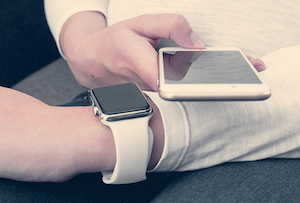 A smartwatch and smartphone equipped with Braidios can work together to proportionally share the energy consumed for communication. Image credit: Pixabay.To address this issue, the researchers designed a radio with the ability to offload energy to larger devices nearby, in effect making both device size and battery consumption proportional to the size of battery. To achieve this, they embellished the commonly used radio technology Bluetooth with the ability to operate in a manner similar to radiofrequency identification (RFID), which operates asymmetrically—i.e., a reader does most of the work and pays the majority of the energy cost of communication, while a tag, typically embedded in a smaller device or object, is extremely power efficient.
Braidio operates like a standard Bluetooth radio when a device has sufficient energy but operates like RFID when energy is low, offloading energy use to a device with a larger battery when required. Thus, when a smartwatch and smartphone are equipped with Braidios, they can work together to proportionally share the energy consumed for communication.
Their test results show that when a device with a small battery is transmitting to another with a large battery, Braidio can offer roughly 400 times longer battery life than Bluetooth, since the smaller device’s battery is preserved longer.
The team designed Braidio’s radiofrequency front end so that it can operate in different modes while consuming power comparable to a Bluetooth radio and using simple, low-cost components. They also designed algorithms that monitor the channel and energy at the transmitter and receiver and switch dynamically between modes to accomplish power-proportional communication without sacrificing throughput.
With further optimization, the researchers believe Braidio or similar radios can be made smaller and more efficient for mass-market needs.