Body Heat as a Power Source
John Simpson | September 16, 2016Chinese scientists are aiming to obtain the energy for a wearable power source for wearable electronics from body heat.
Muscle activity and metabolism cause the human body to produce constant heat, some of which is released through the skin into the air. However, the relatively small difference between the temperature of skin and that of the surrounding environment means it can be difficult to make effective use of body heat.
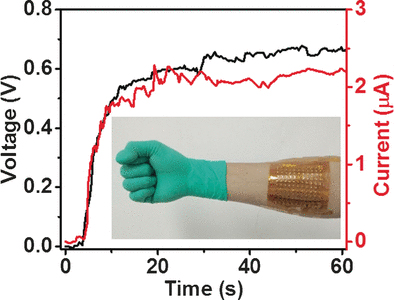 Taking advantage of the thermogalvanic effect, researchers were able to produce 0.7 volts and about 0.3 µW from body heat in a 5° Celsius environment. Image credit: Wiley.Previous thermoelectric generators, such as those based on semiconductors, produce too little energy, are costly or are too brittle for use in wearable systems. Thermocells with electrolyte solutions have proven difficult to integrate into extensive wearable systems.
A team led by Jun Zhou, professor of optoelectronics at China's Huazhong University of Science and Technology, has now found a solution to this problem: thermocells with gel-based electrolytes. The researchers are making use of the thermogalvanic effect: if two electrodes in contact with an electrolyte solution—or an electrolyte gel—are kept at different temperatures, a potential difference is generated. The ions of a redox pair in the electrolyte can rapidly switch between two different charge states, accepting or releasing electrons at electrodes with a different temperature.
In order to use this to produce a current, the scientists combined two types of cells containing two different redox pairs. Each cell consists of two tiny metal plates that act as electrodes, with an electrolyte gel in between. The first cell type contains the Fe2+/Fe3+ redox pair. The second type of cell contains the complex ions [Fe(CN)6]3−/[Fe(CN)6]4−. Because of the choice of these redox pairs, in cell type 1 the cold end gives a negative potential, while in type 2 the cold end gives a positive potential.
The researchers arranged many of these two types of cells into a checkerboard pattern. The cells were connected to each other by metal plates alternating above and below, to link them into a series. They then integrated this “checkerboard” into a glove.
When the glove is worn, the desired temperature difference results between the upper and lower plates. This produces a voltage between neighboring cells, and the voltage adds up, making it possible to generate current to power a device or charge a battery.
In a 5° Celsius environment, it was possible to produce 0.7 volts and about 0.3 µW. By optimizing this system, the researchers believe it will be possible to improve the power, even with smaller temperature gradients.